Topic Segmentation and Meeting Structure Inference From Transcripts
Algorithms extract topics and meeting phases from messy transcripts.
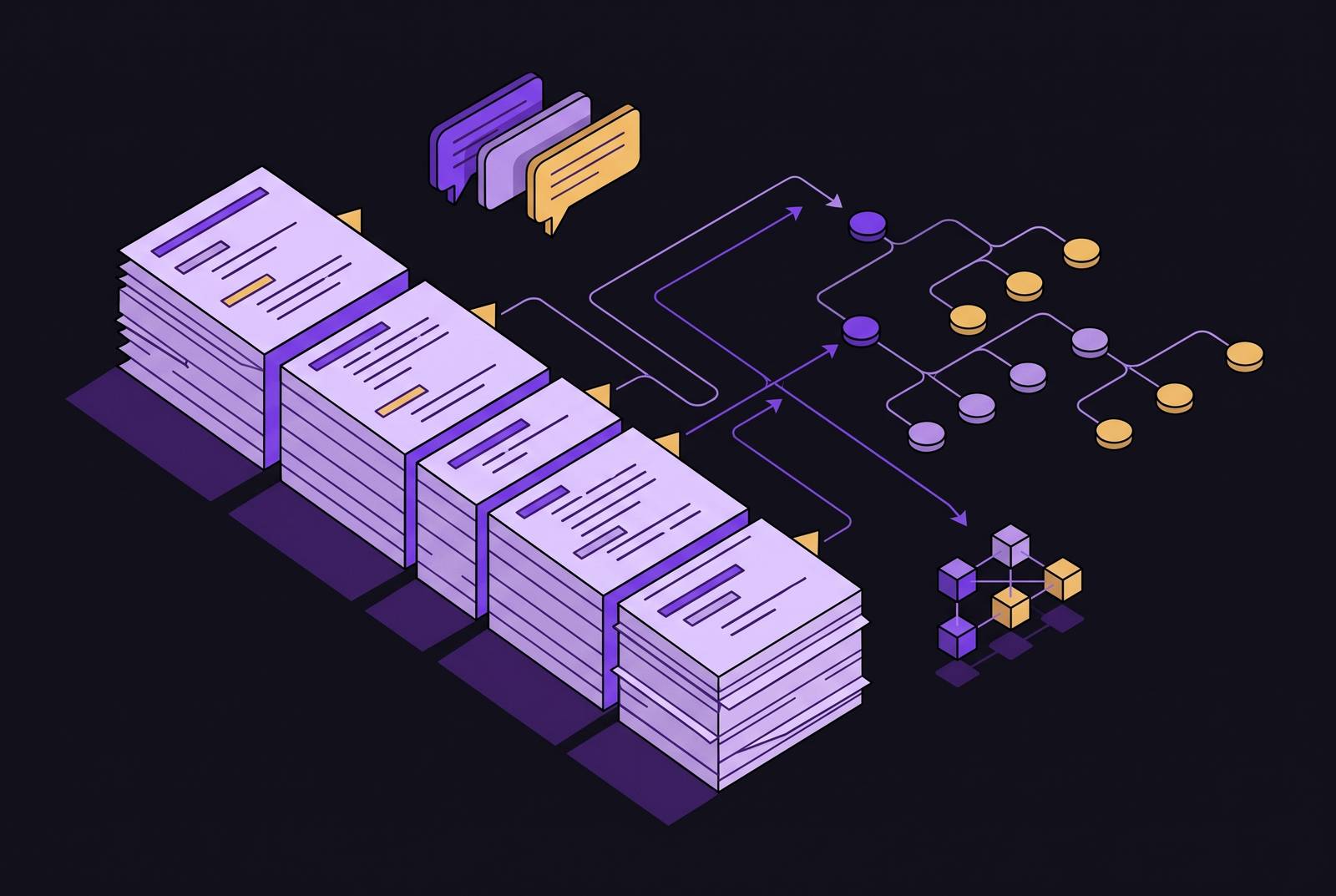
A transcript tells you what was said. It does not tell you what it meant, who was steering the conversation, or where one subject stopped and another started. Ask someone to find "what we decided about pricing" inside a meeting transcript: the search becomes a scroll through an undifferentiated block of text with no markers for decision, debate, or digression. The gap between a verbatim record and a usable one is a structure problem, and no amount of word-level precision fixes it. Meetings move through phases, agenda review, status updates, a decision point, open discussion, next steps, but the raw text carries none of those labels. Zoom's 2026 IT decision-maker guide names the cost of that gap directly: when knowledge workers can't find decisions, action items, or context from meetings they missed, they file support tickets, redo work already done, and ask questions that were already answered.
The transcription pipeline that produces the raw text structure inference operates on
Every structural technique described in this piece works on text produced by an earlier pipeline, and that pipeline sets the ceiling on what can be recovered later. The quality of the ASR system upstream directly constrains what topic segmentation, phase inference, and every other downstream technique can do with the output. The process starts with audio preprocessing: noise removal and volume normalization happen before any speech model touches the recording, and Zoom's guide points out that audio quality, background noise, and compression all shape what comes out the other end. From there, acoustic modeling takes over, with a deep learning model mapping audio features to likely phoneme or subword sequences, which then get decoded into full word sequences. A language model re-ranks those sequences by contextual probability, which is how a system correctly hears "Zoom AI" instead of "zoom a eye". Finally, NLP post-processing adds punctuation, corrects domain terms, and formats the raw output into something readable.
By the time a transcript reaches a structure-inference system, it is already a best guess, not a ground-truth record, and every error introduced earlier compounds in the layers built on top of it. Verbit's 2025 guide found that models like Wav2Vec 2.0 still produce high word error rates on non-English audio. This means the "good enough" bar for structure inference isn't cleared everywhere a transcript gets generated. Azeus Convene's 2025 overview confirms custom vocabulary and domain adaptation, uploading dictionaries for legal terms, medical abbreviations, or product names, are now standard enterprise features, because jargon is where raw ASR breaks down most visibly. The text that topic segmentation and diarization operate on is this reconstructed, imperfect output rather than a clean record of what was actually said.
Speaker diarization as the first layer of structure
Diarization, the task of figuring out who said what, looks like a convenience feature. It's better understood as the first layer of infrastructure everything else depends on, because in a meeting, knowing who is speaking is inseparable from knowing what is happening. By 2025, diarization systems can tell apart up to 30 unique speakers in a single recording, and in enterprise settings, that capability links to SSO user profiles, so transcripts carry named tags instead of generic "Speaker 1" placeholders. That link between a vocal pattern and an identity is what makes every higher-level inference possible.
Speaker identity does more than attribute quotes correctly. It surfaces behavioral patterns that encode meeting structure on their own. A speaker who asks questions throughout a stretch of conversation signals a Q&A phase, while a speaker who holds the floor uninterrupted signals a presentation. None of that is visible to a system working from a plain text stream with no speaker attribution.
This does raise a real risk: a diarization error at the exact moment a topic shifts can cause a segmentation model to misattribute the transition entirely, confusing a change in speaker for a change in subject or vice versa. Enterprise tools address this through SSO-linked profiles and custom speaker enrollment, which reduce the error rate rather than eliminate it. Diarization accuracy is a constraint that every layer above it has to work around.
Topic segmentation, dividing the transcript into coherent topical units
Topic segmentation takes a linear stream of text and divides it into segments that each cover one coherent subject; whether a later summary, search result, or action item gets scoped to the right conversation depends on it. The task breaks into two distinct problems. First, a model has to find the boundary, the point where one topic ends and the next begins. Second, it has to label what the segment it just found is actually about. In a written document, this would be a relatively tractable problem, since paragraphs and headers already do some of the work. In a meeting, nothing does. Participants loop back to a point raised earlier, chase a tangent, then return to the original agenda item as though no detour happened at all, which makes clean boundary detection far harder to pull off than in text that was written rather than spoken.
Statistical and embedding-based methods approach the problem by tracking semantic shifts, watching for the moments where the vector representation of the conversation changes meaningfully, and treating those shifts as candidate boundaries. Large language models layered on top of ASR output go further than boundary detection: they apply contextual understanding to label each segment and generate a segment-level summary, rather than just marking where a change occurred. Zoom's IT guide describes exactly this layering, noting that modern transcription tools put LLMs on top of ASR output specifically to generate summaries, extract action items, and answer questions drawn from the transcript.
What correct segmentation makes possible is worth seeing concretely. A structured output like the one Plaud Intelligence produces breaks a long workshop recording into segments that roughly track its actual phases, letting someone locate "the prioritization discussion" or a particular group's debrief without scrubbing through hours of audio to find it. That kind of navigation only works if the underlying segmentation drew its boundaries in the right places. And the ceiling on how well that works isn't just a function of how sophisticated the segmentation model is: audio quality upstream and whether the LLM summarization layer has been tuned to the meeting's own domain both shape the result just as much.
Agenda-phase inference, recovering meeting structure that was never written down
Finding where a topic changes is only part of the job. A harder problem sits on top of it: classifying what kind of conversational activity is actually taking place inside each segment. A topic label like "pricing" tells a reader what content falls within a segment, but it says nothing about whether that content was a proposal, a disagreement, or a final decision. A phase label, "decision point on pricing," tells the reader what happened and how much weight to give it. That distinction matters directly for anything built on top of the transcript: an action item pulled from a segment labeled "discussion" carries a different level of confidence than one pulled from a segment labeled "commitments" or "next steps," and phase classification is what lets a downstream system weight the two differently.
Systems infer these phases without ever seeing a written agenda, largely by reading linguistic cues. Phrases like "so we've agreed," "who owns this," "let's move on," and "any questions" function as strong signals of a phase transition, and LLMs are trained specifically to recognize them. This is where diarization and segmentation start working together rather than in isolation. A shift from multi-party crosstalk to one dominant, uninterrupted speaker often marks the start of a presentation phase, and a return to multi-party exchange marks a return to open discussion, the same speaker-pattern signal introduced earlier doing double duty as a phase-transition marker. Structural cues reinforce both: opening patterns like introductions and agenda review, and closing patterns like next steps and scheduling, are detectable even with no written agenda to check against.
When a written agenda does exist, it changes the inference task considerably. A tool that ingests the calendar invite or agenda document ahead of the meeting has a prior to align its inferred segments against, matching detected phases to named agenda items instead of generating labels with nothing to anchor them. The layered system becomes visible here: transcription produces the text, diarization attributes it, segmentation finds the boundaries, and phase inference reads the result against both linguistic and speaker-pattern evidence to recover structure that was never written down anywhere.
Structure quality and downstream accuracy
Everything downstream, the summary a reader skims, the action item routed to someone's task list, the answer returned by a search, is bounded by the structural inference that scoped it, and that inference is the prerequisite for whether the product works.
Consider what happens when a segment boundary lands in the wrong place. A summary generated from a misdrawn segment conflates two separate topics into one, or splits a single decision across two different summaries, and the fault in that outcome traces back to the segmentation that defined what the summarizer was asked to condense, not to the summarization model itself. Action item extraction runs into the same dependency from a different angle. An item pulled from a hypothetical aside, "we could assign this to marketing", carries a different status than one pulled from an actual commitments segment, "Sarah will send the brief by Friday", and a system that cannot distinguish the phase cannot distinguish the item.
Search across meeting history depends on the same foundation. A query like "what did we decide about the integration timeline" can only return a precise answer if the relevant segment was bounded correctly and labeled as a decision point when the transcript was first processed. Account-level memory, the ability to query every meeting with a given customer and surface patterns and decisions across all of them, only works if each individual meeting's segments were labeled correctly at the moment they were created. Meeting intelligence builds value over time, but only because consistent structure lets accumulated history be queried reliably across months of meetings. Inconsistent structure doesn't just degrade one meeting's output. It degrades every query that ever tries to reach across multiple meetings at once.
Where structure inference succeeds and fails
Structure inference holds up well in meetings with clear phase transitions and a single dominant language running through them. It gets brittle fast in conditions that show up constantly in real enterprise use: code-switching, overlapping speech, poor audio quality, and missing agenda priors each degrade accuracy in specific, identifiable ways.
Poor audio quality upstream remains the primary ceiling on accuracy, and no segmentation model, however well designed, can recover structure from a transcript that was corrupted before it ever reached the model. Code-switching, participants shifting between languages mid-sentence, breaks both diarization and topic boundary detection at once, since embedding-based semantic shift detection assumes every utterance lives in the same representational space; Azeus Convene's overview notes that only some tools handle code-switching at all. Heavy crosstalk and interruption cause diarization errors in overlapping speech, and those errors propagate directly into topic boundary errors further down the pipeline. Domain-specific jargon without a custom vocabulary in place causes a related failure: when ASR misrecognizes a technical term, the language model built on top of it can assign the entire utterance to the wrong topic cluster. Unstructured freeform meetings, brainstorming sessions and informal working sessions with no agenda pattern to speak of, are the hardest case of all, because the phase-transition signals the model relies on, the linguistic cues, the speaker-pattern shifts, simply aren't present to detect.
None of this is a reason to wait for better models. The more immediate lever is improving the inputs the models already have to work with: pre-loading custom vocabularies, enabling SSO-linked speaker profiles, feeding in the agenda document as a prior before the meeting starts, and recording in low-noise environments. Each of these independently raises the ceiling on what structure inference can recover, regardless of how the underlying models improve over time.
From inferred structure to workflow outputs
Inferred structure only pays off if it gets routed to where work actually happens. A transcript segmented and labeled perfectly, but sitting inside a standalone app nobody else touches, functions as an archive, not an intelligence layer.
The routing itself depends entirely on the quality of the structure feeding it. Action items pulled from a segment correctly labeled as a commitments phase can be pushed, with the right owner and the right deadline, into project tools like Asana and Linear or CRMs like HubSpot, Salesforce, and Attio, because the phase label tells the receiving system these are real commitments rather than hypothetical ones floated in discussion. Decision-segment labels enable governance-heavy tools to produce structured minutes that record only confirmed decisions rather than a full transcript of the deliberation that led to them; OnBoard's 2025 overview describes this exact pattern for board meeting workflows, where the system organizes content into labeled sections running from call to order through motion to adjourn.
The quality of the segmentation directly produces the gap between a shallow integration, one that pushes an unstructured note into another tool, and a structured-object integration, one that writes into discrete CRM fields. A tool that has correctly inferred phase and topic can push an actual deal-stage update into a CRM record. A tool that hasn't can only hand over a block of text and leave someone to read it and decide what to do with it. The distance between those two outcomes is the entire argument of this piece: every output a meeting intelligence product markets, the summary, the task, the searchable record, the account memory, is downstream of the structural inference that made it legible in the first place.
Sources
- AI Meeting Transcription: The Complete Guide for 2026
- How to Master Automated Transcription in 2026: A Step-by-Step Guide - Verbit
- What Is AI Meeting Transcription & Best Tools in 2025
- AI Meeting Transcription Tool: 5 Best Options in 2026
- What is AI transcription? The 2026 guide for IT decision-makers
- 5 Best AI Note Takers for Long-Duration Meetings in 2026