Decision Detection in Meeting Transcripts
AI systems struggle to spot what was actually decided in spoken meetings.
Decision Detection in Meeting Transcripts.
Why meeting decisions are the hardest thing to recover from a transcript
Meeting transcripts contain decisions, but finding them takes more than a search bar and the right keyword. Separating a decision that got made from a topic that merely got aired requires linguistic signal-reading, conversational context, and a layer of natural language processing built specifically for that job. Getting this right matters because the failure mode is what happens after the meeting: nobody can reconstruct what was actually agreed, deadlines slip because nobody owned them clearly, and action items land nowhere in particular.
The math on memory alone should worry anyone who runs a lot of meetings. Participants forget roughly 70% of meeting content within 24 hours, a figure that tracks with decades-old Ebbinghaus forgetting curve research on how quickly recall degrades after an event. Given that the average professional spends around 31 hours a month sitting in meetings, that loss compounds across every one of those hours, week after week.
A transcript doesn't fix this on its own. It answers a narrower question than people assume, namely "what was said," which is fundamentally different from "what was decided." The gap between the moment a decision gets made and the moment it gets documented is where organizational commitments quietly die, not through negligence but through the sheer difficulty of parsing spoken language into discrete, recoverable facts.
This is a signal-extraction problem: ASR converts audio to raw text while the LLM layer interprets that text for meaning, and the two require entirely different tools. Reading back through a transcript, or running a keyword search across it, won't reliably locate a decision, because decisions in spoken language don't appear the way a bolded line in a document does. Which raises the real question: how does a system, artificial or human, distinguish something the room discussed from something the room decided?
Why a "decision" is hard to spot in spoken language
Decisions rarely appear as clean, quotable propositions. They emerge in pieces, spread across a proposal, a counterpoint, some hedging, and a lukewarm nod that somehow becomes the final word. "Let's go with that" can carry exactly as much decisional weight as a formal resolution, even though it reads, on the page, like a throwaway line.
Compare that to how decisions look in writing. A board resolution or a contract clause is syntactically unambiguous, built to be parsed. A spoken decision, by contrast, is tangled up in turn-taking, interruptions, and references that only make sense if you were listening a minute earlier. That structural difference is why decision detection is a genuinely harder problem than document parsing ever was.
In practice, decisions appear in a handful of recognizable shapes. There's the explicit commitment, something like "we're going with option B," about as close to a clean statement as spoken language gets. There's ratification, where someone asks "does everyone agree?" and the room answers with something short like "okay, so we'll proceed". There's delegated resolution, where the decision isn't the outcome itself but the assignment of who gets to make the call, as in "Sarah will make the call on pricing by Thursday". And there's implicit closure, where the topic simply drops and the next agenda item starts, the decision assumed rather than stated. Conditional decisions round out the set: "if legal clears it, we move forward" records a decision that's real but pending.
The hardest case to catch is the one where a topic gets discussed at length but no decision ever lands. Read cold, that transcript can look almost identical to one where a real decision was reached. Conversation, not vocabulary, is where it lies, so keyword matching fails in a fairly fundamental way. Phrases like "we decided," "let's," and "we'll" occur constantly in speculative and hypothetical speech, just as often as they occur in the moment something actually gets locked in. The word was never the signal; the context around it was. That's the core challenge any detection system has to solve, and it has less to do with getting the transcription right and everything to do with interpreting conversational intent semantically.
The NLP and LLM machinery behind decision detection
Under the hood, this runs on a two-layer architecture. Automatic Speech Recognition, or ASR, handles the first layer: it converts audio into raw text. A separate large language model layer sits on top and interprets the text for meaning, a division one technical source summarized cleanly: ASR gives you the words, LLM synthesis extracts the meaning. That split matters, because the hard part of decision detection was never really about hearing correctly. It's about understanding correctly once the words are already on the page.
The LLM layer's job is to interpret text for meaning. It classifies each utterance, sorting statements from questions from commitments from hedges from proposals from ratifications. It tracks conversational state as the meeting unfolds, holding something like a running map of which topics are open, mid-discussion, or resolved. It identifies commitment language specifically, watching for modality markers like "we will" or "that's decided," ownership signals like "Sarah owns this," and closure cues, such as the conversation visibly moving on right after agreement lands. And it has to distinguish tentative language from resolved language, telling "we might do X" apart from "we're doing X," which requires parsing verb modality alongside the surrounding back-and-forth.
Reference resolution adds another layer of difficulty. "Going with the first option" only means something if the system knows what the first option was, which might have been named four minutes earlier in a completely different part of the conversation https://en.wikipedia.org/wiki/AI_notetaker. Speaker diarization, knowing who said what, is a prerequisite for getting any of this right, because a decision announced by the meeting chair carries different institutional weight than the same words offered as a suggestion by one participant among many. Domain adaptation also affects detection accuracy: decision language in a legal context ("we're proceeding") doesn't sound like decision language on a product team ("let's ship it"), and tools that allow custom vocabulary catch more of what's actually being decided in specialized settings.
On the raw mechanics, the industry has largely converged. Transcription accuracy across the leading tools is 90 to 95% or better on clean English audio, according to hands-on testing across eight tools in the category Best AI Meeting Note Takers in 2026: Hands-On Review of 8 Tools justtalkingtech.medium.com. That convergence is exactly why the competitive line has moved elsewhere: the differentiator now is what the model does with the transcript once it exists, meaning structure, classification, and extraction quality, not the transcription step itself Best AI Meeting Note Takers in 2026: Hands-On Review of 8 Tools justtalkingtech.medium.com. Detection still breaks down in predictable places, though. Overlapping speakers, decisions with no explicit verbal marker at all, conditional decisions where the condition never gets revisited, and mid-sentence code-switching between languages all remain genuinely hard cases. And background noise, cheap microphones, and heavy accents degrade the ASR input before the LLM layer ever gets a chance to interpret anything.
How conversational context (not just individual sentences) determines whether something is a decision
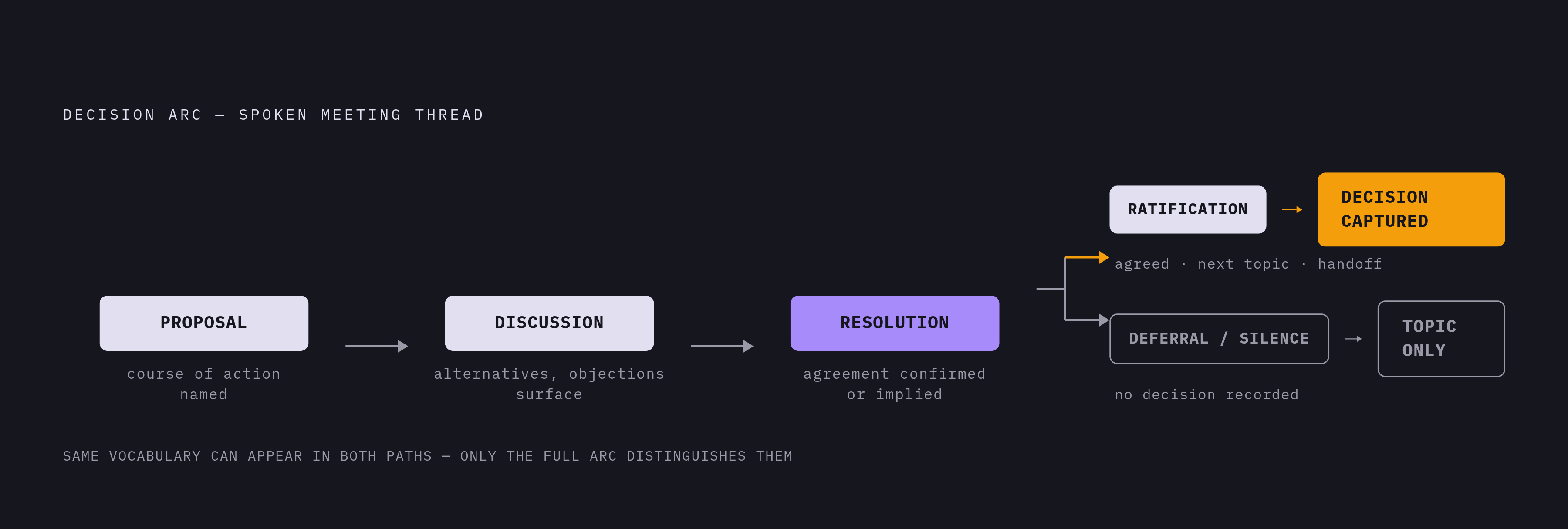
Take the sentence "let's go with that" completely on its own, stripped of everything around it, and it's unclassifiable. You'd need to know what "that" refers to, whether the person speaking actually had the authority to decide anything, and whether the room went along with it or someone pushed back and the conversation kept going.
That's why detection has to operate over windows of conversation rather than individual sentences. A decision typically moves through a proposal phase, where someone names a course of action, then a discussion phase, where alternatives get weighed and objections surface, and finally a resolution phase, where agreement gets confirmed either explicitly or by clear implication. Ratification signals close the loop: a verbal "agreed" or "sounds good," a shift to the next topic, or an explicit handoff of next steps.
The LLM layer maintains something like a running state model across the whole transcript, effectively tracking open threads the way a good facilitator would in their head. A thread that closes with ratification counts as a decision. A thread that closes with deferral, or just trails into silence, does not. That distinction is exactly where sentence-level detection falls apart. A tool built to flag decisions sentence by sentence will throw false positives at every hypothetical in the room and miss every implicit closure, whereas a tool built to track the conversational arc gets both cases right far more often.
There's a useful test here: can the same tool label one meeting's pricing conversation as "raised for discussion" and a follow-up call's pricing conversation, using very similar language, as "decided"? A sales call where pricing comes up but nothing gets locked in, followed a week later by a call where the number gets confirmed, will contain almost identical vocabulary in both transcripts. Only one of them contains an actual decision, and telling those two conversations apart is the entire organizational memory payoff of doing this well.
What good decision output looks like across tools in practice
A label isn't enough. Good decision output is a structured record: what got decided, who decided it or now owns it, any conditions attached, and a timestamp tying it back to the exact moment in the transcript where it happened.
That structure tends to include the decision stated in plain language rather than lifted as a raw quote, attribution naming who committed and who else was in the room, the context of what question or option the decision resolves, any dependencies like "pending legal review," and a link back to the source moment so someone can verify it later. Tools in this space differ noticeably in how far they go toward that standard.
Sembly AI is built specifically to surface decisions, risks, and next steps as separate, structured outputs, and one 2026 industry roundup tagged it as the strongest option for decisions, risks, and accountability specifically, at a starting price around $17 per user per month. OnBoard takes a governance-first approach, generating decisions as a named section within post-meeting minutes and making them queryable through AI Assist, so that, per the company's own description, directors can ask questions about past meetings, surface specific decisions, and retrieve governance context in plain language. Convene AI, aimed at corporate boards, offers a named Action & Decision Assistant alongside its transcription and summarization tools, running on AWS Bedrock.
Granola runs a different model entirely, one that's human-in-the-loop rather than fully automated: a user's own typed notes during the meeting act as targeting signals, and the AI enhancement layer pulls the relevant surrounding transcript content around those flagged moments, with decisions then appearing in structured summaries next to action items; notably, the underlying audio gets deleted immediately after transcription, with no raw recordings retained. Fireflies.ai takes yet another approach, prioritizing distribution of meeting data to downstream systems, though one competitor's analysis characterized it as focused on data export rather than synthesis, meaning content doesn't automatically connect to related conversations happening in Slack or Teams, so piecing together context across channels still takes manual effort.
That split reflects a real tradeoff running through the whole category: fully automated classification, where the AI alone decides what counts as a decision, against a human-anchored model, where a person flags the moment and the AI elaborates around it. Each has a distinct failure mode. Full automation risks false positives, tagging things as decisions that were really just enthusiastic discussion. Human-anchored systems only work if the person in the meeting actually catches the moment in real time, which not everyone reliably does. Neither approach is strictly better; they're suited to different kinds of meetings and different tolerances for error. Looking at where the market has moved by 2026, one analysis of the state of the field found that the differentiator has shifted from transcription accuracy to structure, meaning decisions, action items with named owners, and CRM-ready field outputs, rather than raw transcripts dumped on someone's desk.
Routing detected decisions into the systems where work happens
A detected decision that just sits inside a meeting tool is still an information silo, even if it's a nicely labeled one. The same loss-of-context problem that plagued the original meeting simply recurs one step later, if the decision never travels anywhere beyond the transcript it was found in.
Different kinds of decisions need to land in different places. A pricing decision belongs in a CRM opportunity record. A product direction decision belongs in a project management tool like Linear or Asana. A staffing decision belongs in a Slack channel or an HR system. Routing isn't a single pipe, it's a branching set of destinations, and a meeting intelligence tool that only produces a transcript has no way of sorting decisions into the right one.
Some tools have built this routing directly into their product. Cirrus Insight connects transcripts straight into Salesforce records, so that, in the company's own framing, conversations support real execution for sales teams, with decisions and next steps landing in the CRM without a separate manual step. Avoma combines transcription and summaries with workflows that push follow-up emails, action items, and CRM updates automatically, and its strongest value shows up for sales, customer success, and other customer-facing teams that need meetings to turn into next steps quickly. Gong syncs call summaries, action items, and highlights into CRM records as activity logs, with transcripts accessible directly from the relevant lead or opportunity record, and, on its Enterprise plans, structured CRM field updates for deal progress available through its AI Data Extractor.
None of this should tip into full autonomy without a check somewhere in the loop. One 2026 analysis of automation trends noted that businesses shouldn't hand AI agents full decision-making control right out of the gate, and the safer path is AI that recommends, routes, or reminds before it's trusted to complete actions on its own. Good starting points, per that same analysis, are meeting summaries, approval reminders, and workflow status updates, not autonomous execution.
The infrastructure for this routing is standardizing fast. The Model Context Protocol, introduced by Anthropic in November 2024 and donated to the Linux Foundation's Agentic AI Foundation in December 2025, gives a standardized way to connect AI outputs, including meeting decisions, to downstream tools and models without custom-building a connector for every integration coworker.ai. By December 2025, the protocol had passed 97 million monthly SDK downloads and had more than 10,000 active servers running in production coworker.ai. A meeting tool that exposes decisions as structured data through an MCP connector or API makes those decisions usable by any AI assistant or workflow tool already in a company's stack. The decision becomes a first-class input somewhere, rather than a paragraph buried inside a PDF nobody reopens.
Decisions as the building block of organizational memory
Organizational memory, as a concept, describes a structured, persistent knowledge layer that lets AI systems retain, connect, and apply a company's collective intelligence across every team, tool, and workflow, continuously learning from interactions and decisions rather than just archiving static documents. Decisions are the most durable unit inside that layer. A transcript is ephemeral and a summary is lossy by design, but a decision captured properly, with context, ownership, and a timestamp attached, stays actionable months or years after the meeting it came from is forgotten.
Onboarding makes the stakes concrete. New enterprise hires typically take 6–12 months to reach full productivity, according to Brandon Hall Group research. Organizational memory systems compress that timeline by giving new employees access not just to finished documents but to the reasoning behind past decisions, the "why we chose this vendor" and "why we dropped that feature" that otherwise lives only inside a handful of senior employees' heads. Early adopters of these systems report reductions in onboarding time in the range of 25 to 40% coworker.ai iankhan.com. The next phase of this, per one analysis of organizational amnesia, is a shift toward proactive surfacing: instead of a new hire having to ask what the team decided on pricing, the system surfaces the relevant decision unprompted the moment the topic comes back around.
The scale of what's lost when none of this exists is not small. Fortune 500 companies lose an estimated $31 billion annually to poor knowledge sharing, according to McKinsey research. A decision that goes undetected in a meeting is a compounding gap, because every subsequent meeting that assumes the earlier decision was common knowledge inherits the same blind spot, and the organization ends up re-litigating settled questions without realizing they were ever settled.
What practitioners should look for when evaluating decision detection quality
Transcription accuracy shouldn't factor much into any buying decision anymore. The leading tools have converged on 90 to 95% or better for clean English audio, so the real question is what happens to the words once they've been captured Best AI Meeting Note Takers in 2026: Hands-On Review of 8 Tools justtalkingtech.medium.com.
A handful of concrete questions separate the tools that are doing this well from the ones that are still labeling everything that sounds decisive as a decision. Does the tool distinguish a topic that was merely discussed from one that was actually decided, or does it flag anything with decision-shaped vocabulary regardless of outcome? Are decisions attributed to a specific speaker and timestamped, or do they appear as anonymous, floating summary lines with no way to trace them back? Can the detection be checked against the original transcript moment, or is the reader just expected to trust the output? Does the system handle conditional decisions, the "if X, then Y" kind, or does it only register clean and unconditional resolutions? And how does it treat implicit decisions, the ones where a topic simply closes and the meeting moves on with no one saying the words out loud?
None of these questions are academic. A tool that produces a tidy-looking summary and one that actually preserves what an organization decided, who decided it, and why, long after the meeting itself has been forgotten are not the same thing.