Technical Vocabulary and Domain Adaptation in Meeting Transcription
Domain vocabulary defeats generic models—three engineering fixes solve it at different costs.
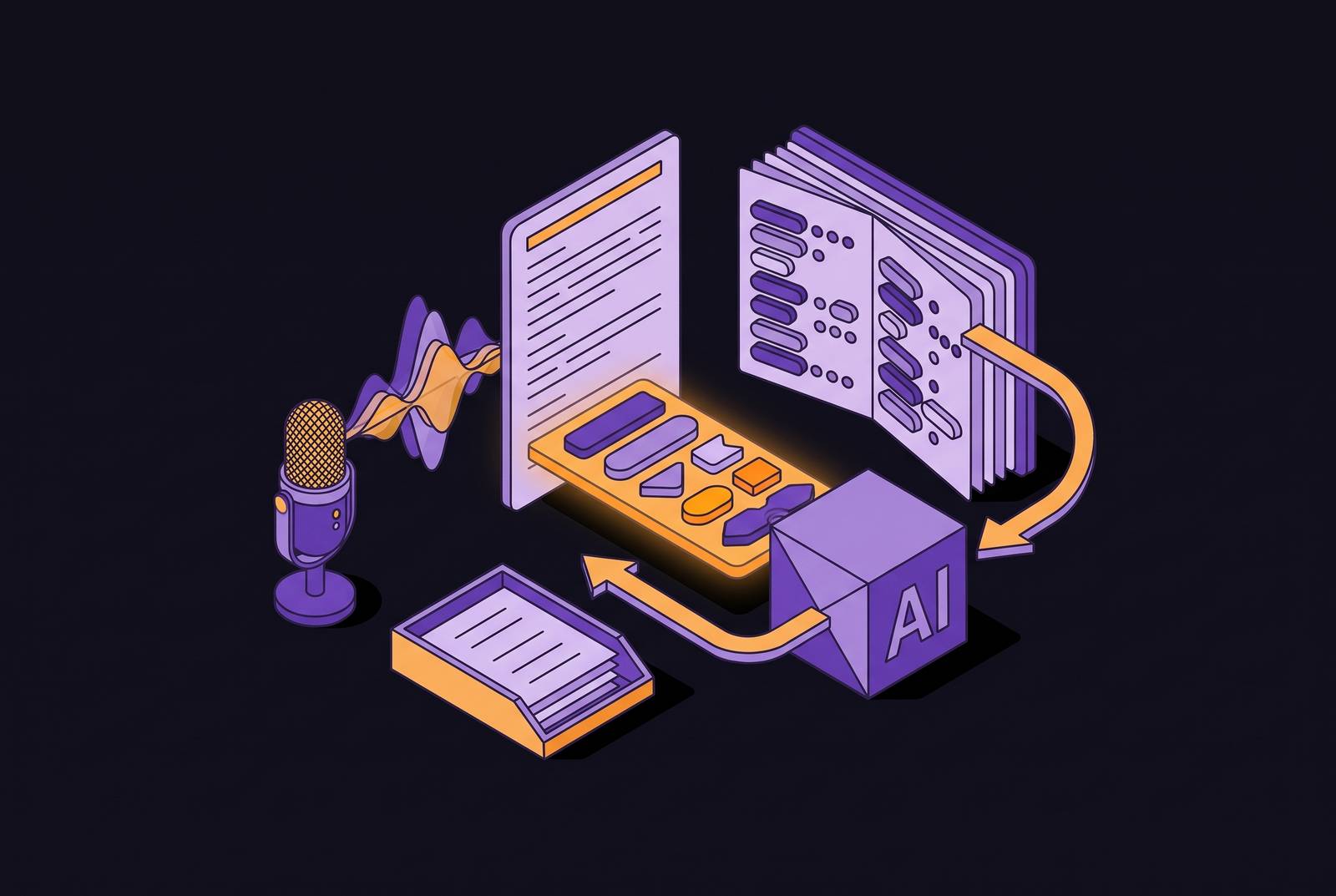
A general-purpose speech model can transcribe a customer support call and a product demo with roughly the same accuracy, right up until someone says "MEDDIC" or reads off a part number. This piece is about that breakdown: why domain-specific vocabulary defeats otherwise strong transcription systems, and what actually fixes it. Jargon, acronyms, part identifiers, brand names, and measurement expressions don't sit inside the statistical range these models were trained on, so error rates climb fast the moment a meeting leaves plain conversational speech.
What word error rate measures, and why 5% can mean thousands of wrong words
Word error rate, or WER, is the standard yardstick across the transcription industry. It's the percentage of words a system gets wrong compared to what a human transcriber would write down, and every vendor benchmark ultimately traces back to this one number.
Here's what that looks like in practice. Research from meetmemo.app finds a typical 30-minute meeting runs around 4,500 spoken words. A 5% WER on that meeting means roughly 225 words come out wrong. Some of those errors are throwaway filler that nobody will notice. Others land on the one technical term that decides whether an action item gets written correctly or not at all.
Research from whisperbot.ai lays out rough production benchmarks: under 10% WER on clean audio, under 20% on medium-quality audio, and under 35% once the recording is degraded, think bad microphones, cross-talk, a bad connection on a conference line. Past those thresholds, chasing a newer core model stops paying off. The bigger gains come from matching the engine to the audio conditions and layering in domain vocabulary support.
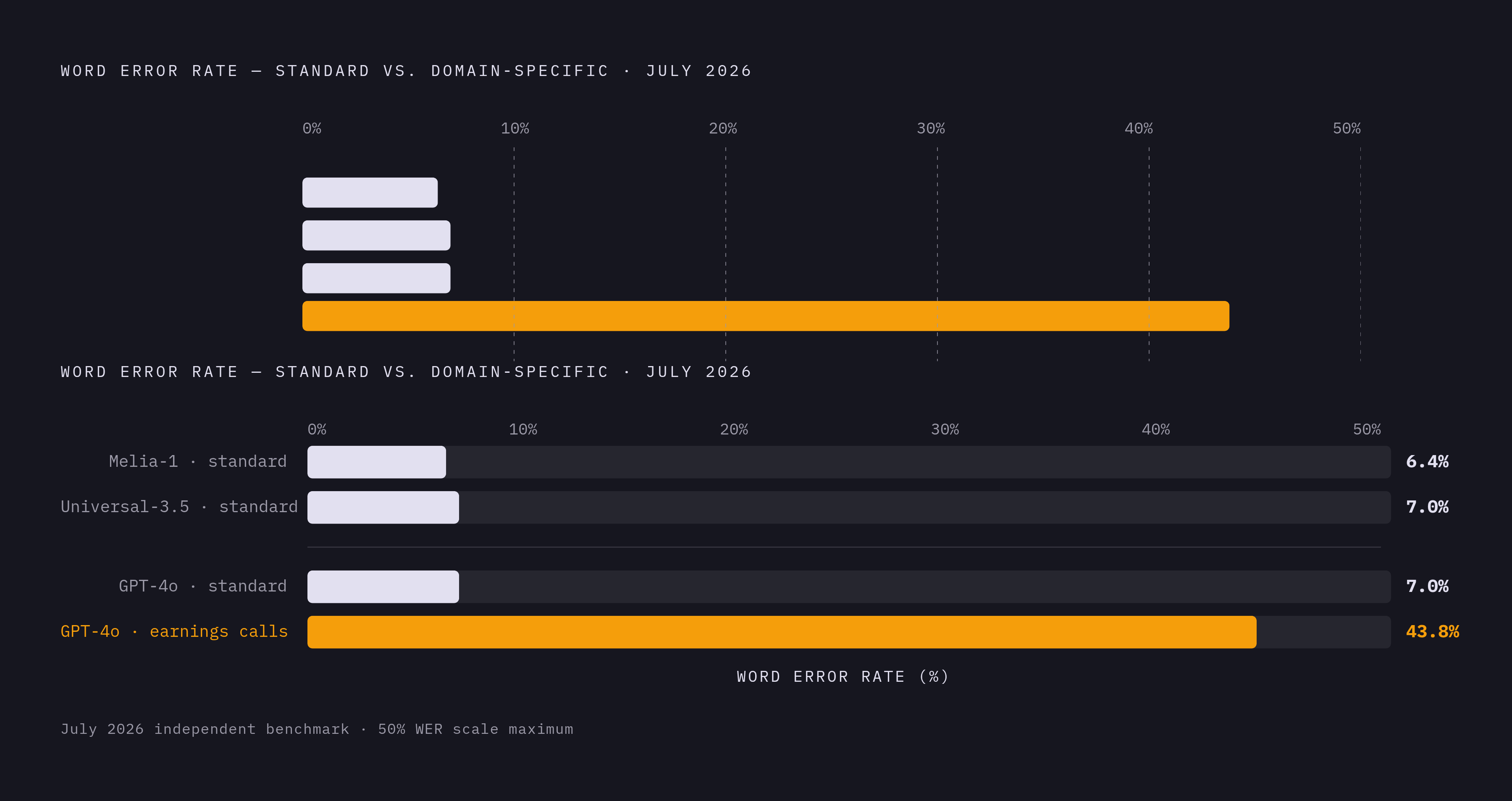
There's a trap hiding inside the WER number itself, though. It's usually measured against generic test sets, broadcast news, call-center audio, casual conversation. A model that scores well on those benchmarks can fall apart the moment it hits a biotech research meeting or a SaaS sales call full of pipeline shorthand. An independent comparison of 14 models across 16 datasets, cited in the forasoft.com vendor guide, put this in stark terms: Speechmatics Melia-1 scored 6.4% WER and AssemblyAI Universal-3.5 scored 7.0% on standard benchmarks, tight numbers, genuinely close competition. But GPT-4o, tested against earnings calls specifically, collapsed to 43.8% WER. Same model family, wildly different result, because earnings calls are packed with company-specific terminology, ticker symbols, and financial shorthand that general benchmarks don't test for.
The takeaway is straightforward: a leaderboard number tells you almost nothing about how a tool will handle your domain's vocabulary. What matters is keyword recall rate on your own audio, not someone else's benchmark set.
Where domain vocabulary causes cascading errors in the full transcription pipeline
Transcription isn't one step, it's a chain, and each link can introduce its own kind of failure. The first stage is automatic speech recognition itself: raw audio waveforms get converted into text tokens. This is where domain vocabulary takes its first hit, since an ASR model trained mostly on everyday speech has no strong prior for a term like "root cause corrective action" or a six-digit part number.
Diarization, the process of figuring out who said what, sits downstream, and errors here compound rather than stay isolated. If the system misattributes a line of speech to the wrong participant, and that line happens to contain a technical commitment ("I'll get the RCA done by Friday"), the resulting action item gets assigned to the wrong person entirely. That's a record that's wrong in two directions at once: wrong speaker, wrong term, and neither error is visible on its own.
Further downstream, action item extraction scans the transcript for commitment language and time expressions, phrases like "I'll send that over" or "by end of week." A misrecognized domain term breaks that pattern match outright. If "MEDDIC" comes out as a nonsense string, or a part number gets garbled into digits that don't correspond to anything real, the extraction logic simply has nothing to grab onto, and the action item never gets generated.
None of these errors stay contained to their stage. A wrong word from the ASR layer flows into diarization, into whatever LLM does the summarization, and finally into whatever CRM field or task-tracking system the workflow writes to. This is the real argument for treating domain adaptation as infrastructure rather than a nice-to-have feature. In specialized meetings, it's the only thing standing between a garbled transcript and a corrupted downstream record.
How domain adaptation works: three mechanisms and what each one costs
Three distinct engineering approaches solve this problem, and they come with real trade-offs in cost, latency, and how much specialized data they need.
The simplest is custom vocabulary injection. Users upload a list of domain terms, legal abbreviations, medical codes, brand names, and product identifiers, and the ASR engine biases its output toward those terms whenever the phonetic evidence is ambiguous. It's cheap, it deploys fast, and it needs no retraining. According to azeusconvene.com, most meeting transcription tools now support uploading custom dictionaries for exactly this reason. Static lists go stale fast, and they can't handle a brand-new term or resolve context-dependent ambiguity, where the same sound could map to two different valid words depending on what's being discussed.
The second mechanism is context prompting at the LLM layer. Instead of relying on a fixed list, the model uses the surrounding conversation to disambiguate technical terms in real time, this is a core advantage of context-aware transcription systems over static-vocabulary approaches. The forasoft.com vendor guide notes that AssemblyAI's Universal-3.5 offers promptable output that gets meaningful domain coverage without requiring a full fine-tune. The cost here is architectural: it needs a capable LLM sitting in the pipeline, latency goes up, and the approach works far better in post-meeting processing than it does live.
The third and most involved mechanism is fine-tuning, and the current research frontier for this comes from a 2026 PHM Society paper by Kumar et al. at Hitachi America. Their pipeline combines synthetic benchmarking with Low-Rank Adaptation (LoRA) fine-tuning of Whisper Large-v3 on synthetic audio-text pairs, then validates the results against real-world recordings. The results showed consistent gains in both word error rate and character error rate on held-out synthetic data and on real recordings alike. Synthetic data generation paired with LoRA fine-tuning is computationally practical even in domains where labeled speech is scarce, which describes most specialized industries. The trade-off is that it still needs curated domain text to generate synthetic audio in the first place, and it demands far more engineering effort than a vocabulary list. It fits best in enterprise deployments with a defined, stable domain, automotive diagnostics, radiology, legal depositions, places where the vocabulary doesn't shift week to week.
These three approaches aren't competitors so much as layers. Production systems increasingly stack all three, a fine-tuned base model, a context prompt, and a custom vocabulary list, to cover as much ground as possible. A guide from memories.ai notes that some tools now adapt to an organization's vocabulary incrementally over time rather than requiring a one-time fine-tuning pass, which amounts to an always-on version of the same idea.
Where the accuracy gap still bites: real-time transcription vs. post-meeting processing
Architecture decides how much of that adaptation stack actually gets to run. Real-time streaming transcription prioritizes speed above everything, which means the output arrives fragmented, and the LLM's context window at any given instant is incomplete. That incomplete context window directly weakens the model's ability to disambiguate technical terms mid-sentence, because the disambiguation trick depends on having enough surrounding conversation to work with.
Post-meeting batch processing doesn't have that constraint. The full transcript exists before synthesis even starts, so the LLM layer gets complete context, and context prompting becomes far more effective as a result. Granola's blog describes an approach that processes the full transcript immediately once a meeting ends rather than trying to structure content on the fly, precisely to avoid the cleanup burden that live streaming output tends to produce.
Cost and latency numbers back up why the two use cases stay architecturally separate. The forasoft.com guide cites sub-300 millisecond latency requirements for voice agents, versus meeting summaries that can run in batch mode at roughly half the per-minute cost (batch pricing around $0.0043 per minute against $0.0077 for streaming). The use case should dictate the architecture, not the other way around.
A domain adaptation consequence is buried in this choice, and it's easy to miss. A fine-tuned model dropped into a streaming pipeline still can't use full-conversation context, no matter how well-trained it is on the domain vocabulary. A batch pipeline with a capable LLM layer can. So teams picking between real-time and post-meeting architectures are, whether they realize it or not, also picking their ceiling for domain accuracy. Neither architecture is universally correct. Live visibility into the transcript may matter more than post-meeting structural quality for the meetings in question.
How accuracy has (and hasn't) been commoditized across the leading engines in 2026
On the surface, transcription accuracy looks like a solved problem. Research from simular.ai on independent testing of the top eight tools found all eight hitting 90 to 95%+ accuracy on standard English audio. Separate figures from laxis.com put leading models at 95%+ word accuracy on clean recordings and 85 to 90% even in tougher multi-speaker settings with cross-talk, accents, and domain jargon mixed in. By that read, raw accuracy at the top of the market has largely flattened out.
But that consensus cracks under stress testing. The same July 2026 benchmark that put Speechmatics Melia-1 and AssemblyAI Universal-3.5 within a point of each other, 6.4% versus 7.0% WER, also showed GPT-4o falling to 43.8% WER specifically on earnings calls. The ceiling that looks commoditized on generic audio shatters the moment domain-specific stress enters the picture.
The forasoft.com vendor guide's 2026 shortlist names Deepgram Nova-3, OpenAI's gpt-4o-transcribe and Realtime models, AssemblyAI Universal-3.5, Speechmatics Ursa 2, Google Chirp 3, and Azure AI Speech as the engines worth evaluating. Among these, Speechmatics Ursa 2 stands out for a specific reason: it cut WER by 18% across more than 50 languages compared to its predecessor, and scored 92% accuracy in a G2 Spring 2026 comparison.
Compliance narrows this field independently of anything related to accuracy. Several major cloud speech vendors sign data protection agreements covering healthcare use; one of them will sign such an agreement for its speech-to-text product, but only when explicitly enabled. The same forasoft.com guide states that workloads confined to the EU generally need a containerized or regional deployment rather than a standard cloud API call. Picking a model isn't just about which one hits the lowest WER, it's about which one is even legally usable for the meeting content in question.
What's changed most in 2026 isn't the accuracy ceiling but what counts as the product. Laxis.com reports that leading tools now compete on producing decisions, action items with named owners, and CRM-ready fields rather than raw transcripts alone. Domain adaptation matters most at that structural layer now, not at the level of individual word accuracy.
Multilingual meetings and the code-switching problem general models consistently underestimate
Code-switching, where speakers move between two or more languages mid-sentence or mid-meeting, appears constantly on international teams, and it appears just as often in domain-heavy meetings where the technical vocabulary itself is in English while the surrounding conversation runs in another language. It's one of the harder problems in the field, and general-purpose models routinely underestimate how often it happens.
Azeusconvene.com notes that some transcription tools support multiple languages and dialects, including code-switching, but "some" is carrying real weight in that sentence, because language support varies sharply from tool to tool. Research from get-alfred.ai lays out the spread directly: some platforms support 60 or more languages, others cover around 38 languages but see accuracy drop noticeably on accented speech, some cap out around 10 languages on desktop, and others perform best only within a narrow set of two or three languages before quality degrades.
Speechmatics Ursa 2's 18% WER reduction across more than 50 languages, mentioned earlier, matters here for a specific reason: multilingual accuracy gains at that scale are genuinely hard to achieve, and the result suggests language breadth and domain adaptation aren't mutually exclusive engineering goals, even though they're often treated that way in vendor marketing.
The connection back to domain vocabulary is direct. Technical jargon spoken inside a non-English meeting is a double adaptation problem: the model has to handle the language and the specialized vocabulary at the same time, and a model tuned well for one often loses ground on the other. For teams with genuinely global membership, the number of supported languages printed on a pricing page is mostly a marketing figure. What actually matters is whether the tool holds onto structural accuracy, correct action items, correct decisions, in the language the meeting is actually conducted in, not just whether it produces some output at all.
What buyers should evaluate when domain accuracy matters for their meetings
Start with actual audio from actual meetings, not a benchmark chart. The GPT-4o result from July 2026, 43.8% WER on earnings calls despite strong general benchmark scores, is the clearest evidence available that generic accuracy claims don't predict domain performance. The only test worth trusting is your vocabulary, on your audio quality, run through the tool being evaluated.
From there, the evaluation gets specific fast. Can a custom vocabulary list be uploaded, and how large can that list get before it stops helping? Does the tool run context-aware LLM synthesis on top of the transcript, or is the output pure ASR with no disambiguation layer at all? For organizations with a genuinely stable, specialized domain, does the vendor offer fine-tuning or a domain-specific model variant, or is customization limited to vocabulary lists alone?
Test the structural output, not just the raw transcript. A tool posting 95% word accuracy that still garbles the one technical term inside an action item has failed the test that actually matters, even though its headline number looks clean. Check multilingual and code-switching handling against the real composition of the teams using it, not the language count printed in a marketing deck.
Diarization deserves its own scrutiny in domain-heavy meetings, since a misattributed speaker on a technical commitment is a workflow failure, not a cosmetic one. Industry research shows that diarization error rates of 11 to 13% on standard benchmarks represent a baseline industry performance level, not a ceiling to be satisfied with.
And compliance has to sit in the same evaluation as accuracy, not after it. Data residency requirements, BAA availability for regulated industries, and regional deployment options all narrow the realistic vendor shortlist before word error rate even enters the conversation. A model that transcribes perfectly but can't legally touch the meeting content in question was never a real option to begin with.
Sources
- What Is AI Meeting Transcription & Best Tools in 2025 | Convene
- AI Meeting Transcription: The Complete Guide for 2026
- Domain Adaptation of Automatic Speech Recognition Models for Diagnostic Applications | PHM Society European Conference
- Top AI Speech Recognition Software in 2026: Vendor Guide
- whisperbot.ai
- simular.ai