Hallucination Risks in Meeting Summarization
AI notetakers hallucinate in ways that are harder to catch.
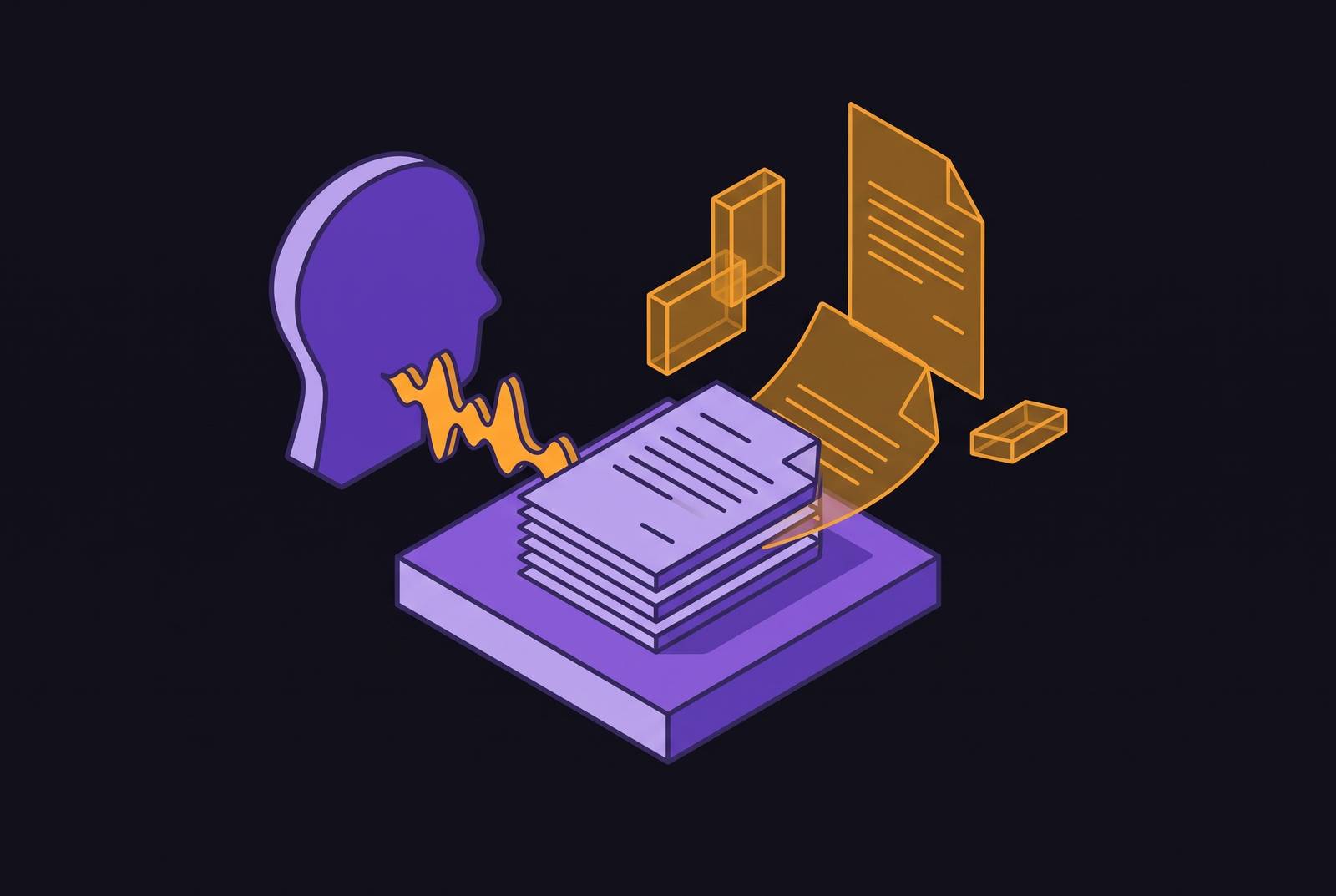
Meeting summarization has a hallucination problem that looks nothing like the one people worry about when they talk to a chatbot. Most professionals now run an AI notetaker in their work meetings, which makes this a standing operational dependency rather than a novelty someone is still testing out. The risk isn't that the tool gets something wrong. It's that the reader sitting across from that wrong answer is the one person least likely to catch it.
Why meeting summarization is a distinct hallucination surface
Most people hedge when asked whether they trust ChatGPT's output, because they know to check. If that same person is asked whether they trust the recap their notetaker just sent from a call they personally attended, the hedge disappears. Believing the recap simply because the person attended the call is the trap. General-purpose LLM hallucination is dangerous because a user might believe something false. Meeting hallucination is more dangerous because the user almost certainly will, since the output arrives formatted as authoritative notes from a conversation they were physically present for, and that framing suppresses the skepticism reflex that would otherwise kick in.
The irony is that presence doesn't actually protect anyone. Participants forget roughly half of what happened in a meeting within a day, and most people spend the meeting itself typing, half-listening, or thinking about the next agenda item rather than building a durable memory of who said what. So when the summary lands, there's no internal record to check it against. The AI's version becomes the only version.
That would be a tolerable risk if the output stayed contained, something to skim and forget. But the output does not stay contained, since it gets operationalized almost immediately. Meeting AI output gets operationalized almost immediately: it drives CRM entries, informs performance reviews, and shapes what an organization remembers about its own decisions. A hallucination doesn't sit in a chat window waiting for someone to question it. It moves downstream, into systems of record, before anyone has a reason to look twice.
The four-stage pipeline where errors enter and compound
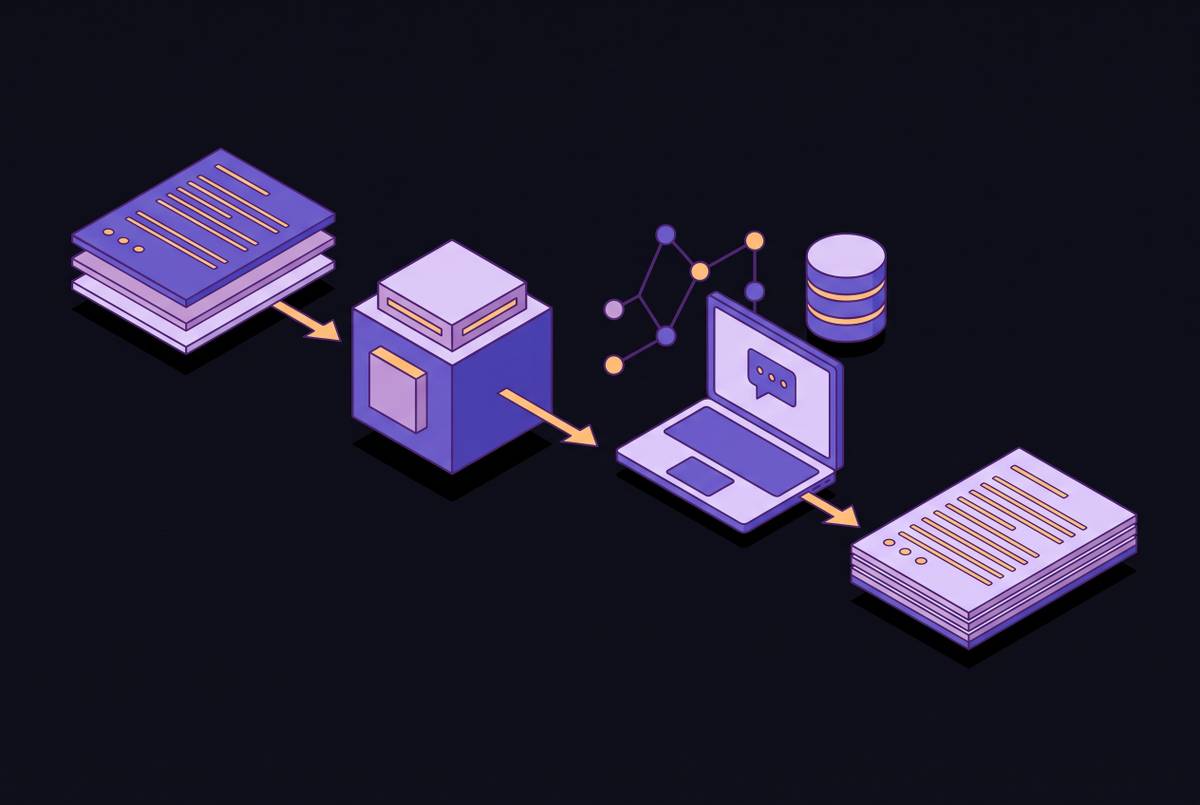
To understand where these errors originate, it helps to break the process into its actual stages. Each stage feeds the next, so an error introduced early doesn't stay isolated. A misheard word becomes a wrong attribution, and a wrong attribution becomes an incorrect action item sitting in someone's task list.
Transcription itself has gotten remarkably good, at least in the conditions vendors like to demo. Leading tools now perform strongly on English audio under controlled circumstances, and accuracy there has largely become commoditized across the major players. The real differentiator isn't the clean-room number. It's how a given tool handles the gap between lab conditions and live meetings, since transcription accuracy has largely been commoditized among leading tools, with top tools performing strongly on English in controlled conditions.
That gap is where diarization becomes the quiet bottleneck nobody budgets for. Even state-of-the-art diarization systems carry non-trivial error rates, and the primary cause is crosstalk: accuracy drops substantially the moment two people speak at once, and real meetings are full of exactly that kind of overlap. If the system assigns a comment to the wrong person, and that comment happens to contain a commitment, the resulting action item gets attributed to someone who never said it. The summarization layer doesn't know the difference. It just inherits the mistake and writes it down with the same confident formatting as everything else. The pipeline has four stages: audio preprocessing, speech-to-text transcription, speaker diarization (who said what), and LLM summarization with action item extraction.
What hallucination looks like in a meeting summary
A useful taxonomy from a 2026 analysis names six distinct failure categories in this space: fabrication of entities, misattribution of real facts, unfaithful summaries of retrieved context, self-contradiction across a response, off-topic drift, and confident refusal of a fact that was actually in scope. Of these, three account for the majority of failures specific to meeting summarization: overconfident paraphrase, unjustified quantification, and speaker misattribution.
Each has a distinct shape once you know to look for it. An invented commitment is subtler: the summary states that "the client agreed to X" when X was floated only as a possibility during a sales call, and now it reads in the recap as a done deal. Picture a planning meeting where someone says "we should probably follow up soon" and the summary renders it as "follow up by Friday," manufacturing a deadline nobody set. That's unjustified quantification, and it's one of the more common failure modes precisely because it looks like helpful specificity rather than invention.
Misattributed decisions follow the diarization failure directly: a real decision gets logged under the wrong speaker's name because the system misassigned the utterance upstream, and now the person credited with making a call had no part in it. Overconfident paraphrase does something quieter still, turning a hedged, exploratory comment, the verbal equivalent of thinking out loud, into a firm conclusion in the write-up. None of these announce themselves. They read exactly like every accurate line around them, because formatted notes carry an implicit claim of fidelity that readers extend without asking for it. Readers treat them like a transcript, not a draft.
Why hallucination rates in meeting AI are lower than the alarming headlines
There's real progress to acknowledge here before any of the caveats. On grounded summarization benchmarks, where a model is anchored to a source document rather than left to draw on general knowledge, top models improved substantially between 2024 and 2025, with several leading models now achieving very low hallucination rates. For the summarization step specifically, that's genuinely good news: an LLM handed a clean transcript is increasingly unlikely to invent content that isn't somewhere in that transcript.
The trouble starts when the task gets less structured. On open-ended factual recall and complex reasoning, hallucination rates for some models climb to 33 to 51 percent, as seen in OpenAI's o3 on PersonQA and SimpleQA respectively. That's not a fluke of one bad model generation, either. Earlier o1 models hovered around 16 percent on those same benchmarks, so the newer, reasoning-optimized models are hallucinating more on open-ended tasks, not less. Across broader task sets that mix simple and complex cases together, rates vary widely and can climb significantly depending on what's being asked.
What should worry a buyer more than any single number is the instability of the numbers themselves. Per the Stanford 2026 AI Index, hallucination rates across frontier models varied enormously, and the same model's accuracy could collapse depending on how the evaluation was framed. When any given output might be confidently wrong, the only sane posture is to assume that risk rather than try to rule it out case by case.
That instability lands directly on meeting AI's weak point. Low hallucination rates at the summarization step depend entirely on the transcript underneath being accurate, and the transcript, not the summary, is the riskier layer. Errors introduced there feed every downstream output the system produces. So the encouraging benchmark numbers are true and largely beside the point: they describe a model behaving well once it's already been handed clean input, which real meetings rarely provide.
Why the model hallucinates in the first place
A September 2025 paper from OpenAI and Georgia Tech researchers, titled "Why Language Models Hallucinate," shows that hallucinations arise from statistical pressures baked into the training pipeline, combined with evaluation procedures that reward confident guessing over honest uncertainty. In other words, the problem isn't a glitch sitting off to one side of an otherwise sound system. It's produced by two forces working together, the way the model was trained and the way it's graded, and both push in the same direction.
That framing matters because it tells you what to expect from future versions of these tools. Better training data, longer reasoning chains, and stronger retrieval methods all measurably reduce hallucination rates, but the underlying tradeoff the research identifies doesn't disappear just because the numbers improve. The correct operating posture, then, isn't waiting for a version that fixes this once. It's treating hallucination as a known, permanent failure mode that has to be detected, monitored, and gated at every stage, the way any competent system handles a risk it cannot eliminate.
Where hallucinations do the most damage: automated workflows and CRM writes
The mechanics above stay mostly academic until a summary starts writing to a system nobody double-checks. When AI-generated notes auto-populate CRM fields without a human reviewing them first, a fabricated commitment or a misattributed action item doesn't just embarrass someone in a follow-up email. It persists in the system of record indefinitely.
Consider a sales call where a customer asks for pricing, nothing more, and the summary renders that as the customer agreeing to a large expansion. That line enters the CRM, shapes the sales forecast, and influences whatever rep inherits the account next, all without anyone flagging that the original conversation never went that far. Tracing it back to the actual meeting after the fact is nearly impossible, because by then the hallucinated line looks exactly like every other CRM entry around it.
The same lack of friction that makes CRM integration valuable is what amplifies the damage a hallucination can do. The less human review sits in the loop, the further a bad output travels before anyone notices it. Speaker misattribution makes this worse in a specific, almost cruel way. If an action item gets logged under the wrong person's name, it may never get done, because the person assigned to it never actually agreed to take it on.
Organizational memory carries its own version of this risk, arguably a larger one. A hallucinated meeting summary that lands in a knowledge base doesn't just distort one workflow. It becomes source material for every future query, onboarding document, or downstream system that draws from that store, quietly compounding with each reuse. Framed at the organizational level, this is a governance failure, not just a model quality issue: in regulated industries, a single erroneous output making its way into the system of record can trigger compliance incidents and real legal exposure.
What the research says reduces hallucination in this context
The strongest evidence points toward architecture, not model choice. Retrieval-Augmented Generation, which forces a model to ground its answers in the transcript as an external document rather than pulling from whatever it absorbed during training, reduces hallucinations by 40 to 71 percent across a range of scenarios. That's the actual reason grounded summarization performs so much better than open-domain generation: the model isn't being asked to remember anything, only to read closely.
Prompt design carries almost as much weight, and it's cheaper to implement than any architectural change. A 2025 study in Nature confirmed that careful prompt structuring meaningfully cuts hallucination rates: telling the model what to extract, decisions, risks, action items, next steps, rather than leaving it to decide what matters on its own, keeps the model focused and reduces confabulation. This is a lever any team can pull today, no vendor change required.
Academic work is starting to formalize this further, but it remains early-stage rather than production-ready. At the AutoMin 2025 challenge on automated meeting summarization, a team calling itself HallucinationIndexes introduced a reinforcement learning approach built around an Entity Hallucination Index, using it as a reward signal that measures factual alignment between generated summaries and source documents through named entities. They used that signal to fine-tune a Flan-T5-Large-based summarization model specifically to penalize entity-level hallucination. Promising, but experimental, and not something showing up in commercial tools yet.
Evaluation design itself affects how strongly a model is incentivized to guess rather than admit uncertainty. Scoring systems that penalize confident errors more heavily than honest abstentions, and that reward a model for expressing uncertainty instead of guessing, reduce the incentive to hallucinate in the first place. Models graded purely on accuracy learn that guessing beats hedging, which is precisely backwards from what a meeting summary needs. Layered defenses, continuous detection pipelines running alongside generation, domain-specific validators checking outputs against known constraints, are emerging in the research literature, though they're not yet standard in commercial meeting tools. They point toward where the field is heading, even if most vendors aren't there yet.
How to evaluate a meeting AI tool for hallucination risk before you commit
Different tools in this category solve different slices of the problem, and it's worth judging each on what it actually claims to do rather than treating "meeting AI" as one undifferentiated category. Some platforms lean into breadth: reporting strong live transcription accuracy in vendor figures, layering in CRM sync, SSO, and SCIM provisioning at the enterprise tier, and offering a chat interface that lets users query across their entire meeting history. Others have moved toward real-time augmentation, adding features that pull in live web search during a call itself so participants can query outside context without leaving the meeting. Sales-specific platforms take a narrower, deeper approach, feeding calls, emails, CRM records, and deal data into a unified graph and building coaching tools on top of it, at custom pricing reflecting the enterprise focus.
None of these approaches is wrong. But whichever one a team picks, the evaluation questions should be the same, and they should go past the accuracy number on the vendor's landing page. Ask how diarization performs specifically under crosstalk, since that's where speaker misattribution actually originates, not in clean single-speaker audio. Ask whether action items and commitments come strictly from the transcript, or whether the model has room to introduce material that was never actually said. Ask, bluntly, whether the CRM integration writes automatically or whether a human has to review and approve entries before they land in the system of record, because that single design choice determines how far a hallucination can travel before someone catches it. Ask whether the organizational memory layer tracks provenance, meaning which meeting, which speaker, what timestamp, for every fact it claims to know. And ask whether output structure is something a team can define, forcing the model to extract decisions, risks, and next steps in a fixed shape, rather than leaving the model free to decide what's worth surfacing on its own.
The tools that deserve trust treat hallucination not as a defect waiting for a patch, but as a permanent operating risk to be measured, bounded, and reviewed at every stage where a wrong word could become a wrong decision.
Sources
- Are AI Hallucinations Getting Better or Worse? We Analyzed the Data | ScottGraffius.com | Blog | Intersection of Project Leadership with Business and Technology
- Findings of the Third Automatic Minuting (AutoMin) Challenge
- AI hallucination examples: 12 real cases and what they teach | Open
- Hallucination Rates in Language Generation
- The Risks Of AI Meeting Notetakers: Evaluating Accuracy