Noise Robustness in Real-World Meeting Environments
Studio benchmarks hide the noise and crosstalk that cuts accuracy in half for real meetings.
Meeting transcription vendors advertise 95 to 98 percent accuracy. That number comes from studio-quality audio: one speaker, no background noise, a clean signal recorded under lab conditions nobody's actual Tuesday standup resembles. Real business audio, cross-talk, a bad laptop mic, someone dialing in from a parking lot, drops the same model's accuracy on typical business meetings to 61.92 percent. That's four words out of ten wrong, in the meetings that matter most, and it's not a rounding error or an edge case. It's the baseline.
Why real-world meeting audio breaks transcription accuracy
The gap between benchmark and reality comes down to what benchmark audio leaves out on purpose. Vendor test sets are built to strip variables: single speaker, clean signal, controlled room. Real meetings do the opposite by nature. Mismatched microphones, room acoustics nobody designed for sound, people talking over each other, speakers whose accents were never well represented in the training data.
Even the frontier models carry this asterisk. ElevenLabs Scribe v2 posts a word error rate of 2.3 percent (97.7 percent accuracy) as of early 2026. That score comes from benchmark audio, the kind recorded under conditions a Tuesday morning stand-up with three people dialing in from their cars never resembles. The 61.92 percent figure for typical business audio is what happens when ordinary conditions meet a model tuned for extraordinary ones, and treating the benchmark number as a planning assumption is the first mistake most teams make.
What word error rate measures and hides
Word error rate is the industry's yardstick, and it's calculated simply: add up substitutions, insertions, and deletions, then divide by the total words in the reference transcript. Clean percentage, fits neatly on a marketing page. It doesn't weigh errors by consequence, and that's the flaw that matters most.
A model that mishears "um" gets penalized the same as one that mishears a dosage, a contract date, or a client's name. WER treats every word as interchangeable, so a transcript can score 98 percent and still contain the one error that costs something real. At that accuracy level, a 1,000-word transcript still carries about 20 mistakes, and nothing guarantees those 20 land somewhere harmless.
WER is also an average across the whole recording, and averages flatten. A meeting might open with ten minutes of near-perfect transcription during a calm one-on-one, then fall apart across a five-minute stretch of crosstalk. The overall score still looks respectable. The decision, the assignment, the number someone has to act on, is most likely to have gotten garbled.
The four acoustic failure modes that degrade meeting transcription
Any one of these problems on its own is manageable. Real meetings stack two or three at once, and that's where accuracy collapses rather than just declines.
Background noise sets the ceiling before anything else does. Distance from the mic, HVAC hum, open-plan chatter, a laptop fan spinning up, keyboard clatter, street noise leaking into a mobile call: all of it degrades the signal before any algorithm touches it. GoTranscript's rule of thumb holds up: if a human has to lean in and strain to catch what someone said, the model will get it wrong too. Cheap hardware makes every other problem on this list worse, because the microphone is the ceiling the software can't lift past, no matter how good the model is downstream.
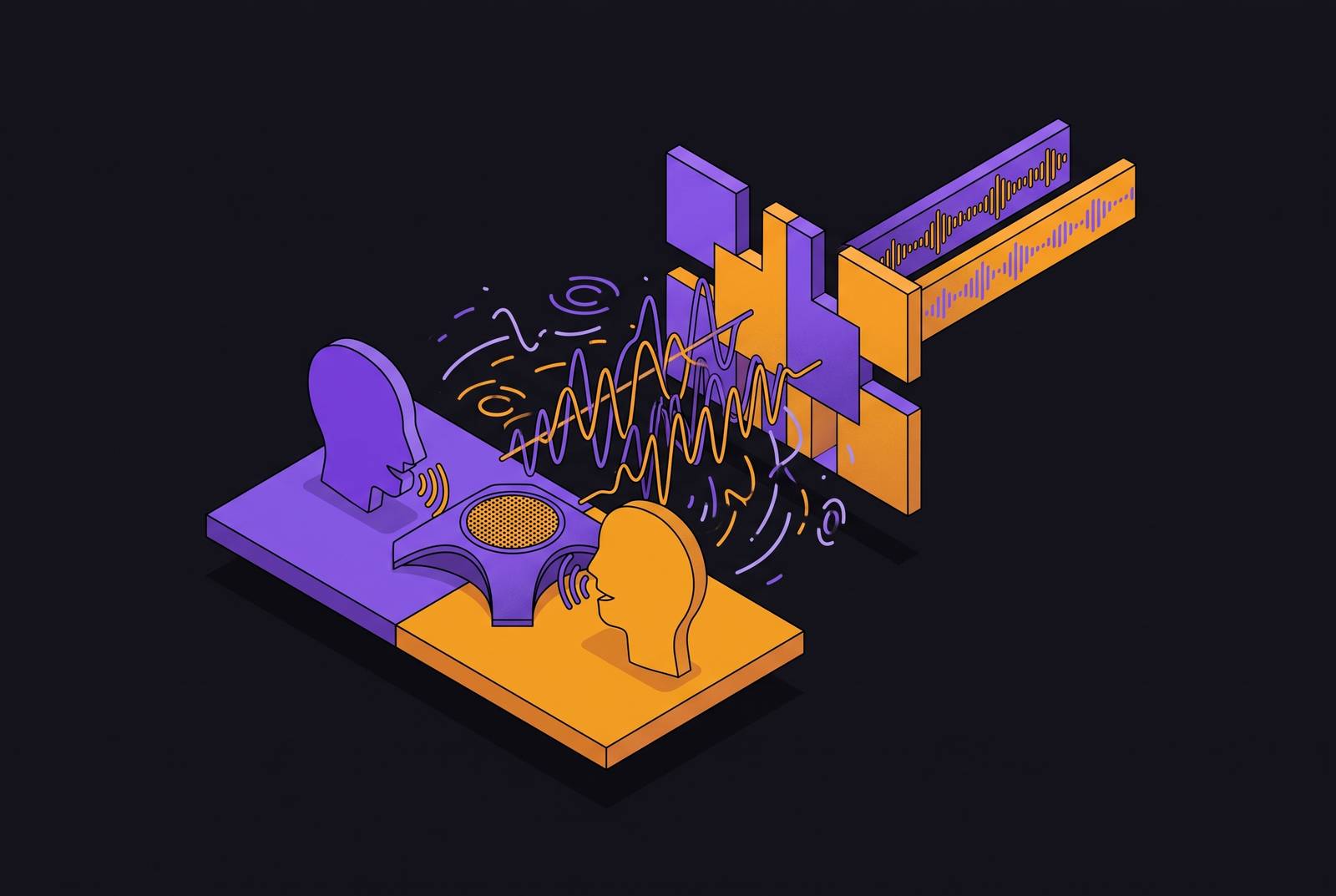
Overlapping speech is the failure mode that hides best. Meetings aren't turn-taking exercises. People interject, talk over each other mid-sentence, throw in a quick "yeah" while someone else is still going. Systems without native speaker diarization, the task of figuring out who said what, tend to merge overlapping speech into one garbled line or hand someone else's words to the wrong person. GoTranscript's own accuracy breakdown puts noisy, accented, overlapping speech below 60 percent, a range where the transcript functions as a rough guide at best. Speaker misattribution doesn't even register in the WER calculation: the words can be exactly right, and the name attached to them wrong, and that failure stays invisible until someone downstream acts on it.
Accents expose the training data's blind spots directly. WER for Midwestern American English is around 3 percent; for Scottish English it's past 17 percent, a sixfold gap that has nothing to do with clarity of speech and everything to do with what the model was trained on. Leading systems in 2025 and 2026 have shown WER as high as 28 percent on accented dialogue. Machine learning advances have narrowed that gap in some systems, but unevenly, and international calls with code-switching between languages compound the problem further. Systems that consistently perform worse on non-dominant accents produce a lower-quality record for those speakers every time they speak, and that's a fairness problem dressed up as a technical one.
Jargon is the failure mode general-purpose models never fully solve. Clean studio speech clears 95 to 98 percent, standard business meetings run 80 to 92 percent, clinical or field recordings run 60 to 82 percent, and noisy, accented, overlapping speech drops below 60 percent. A model that has never seen a company's product codenames or an industry's shorthand will guess, and it guesses using the nearest common word, which is often wrong in a way that reads as confident.
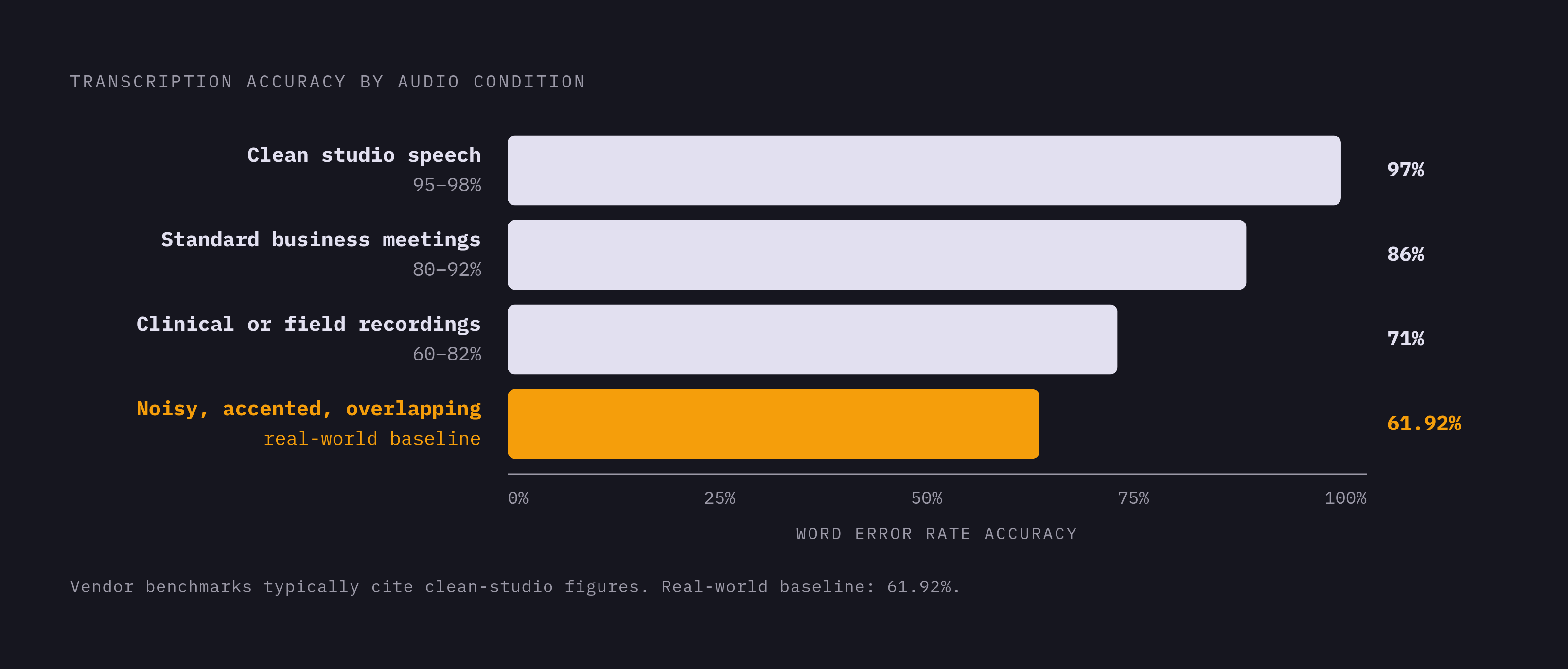
The interaction of failure modes behind the sharp benchmark-to-reality drop
Picture a distributed team call: one participant is Scottish and joining from a café on a laptop mic, and the topic is a new product with a codename the model has never encountered. That single call stacks accented speech, ambient noise, unfamiliar vocabulary, and probably some cross-talk, all at once. None of these problems occurs alone in the real world. They arrive together, and their effects multiply rather than add.
Benchmark audio can't represent this by design, because it's curated specifically to remove the variables that make transcription hard. A benchmark score is a ceiling, not a forecast. Research synthesis on this point is consistent: leading systems post 1 to 4 percent WER on clean English benchmarks, then degrade sharply once accented speech (up to 28 percent WER), background noise, and multiple simultaneous speakers enter the picture. The number on the vendor's homepage and the number a team should actually plan around are two different figures, and conflating them is where budgets and expectations go wrong.
The model landscape when tested on hard audio
TranscribeTube reports that ElevenLabs Scribe v2 leads published benchmarks at 2.3 percent WER as of early 2026. Multimodal systems are closing the gap fast: Gemini has posted 2.9 percent WER on benchmark sets, evidence that the field is moving past pure speech-to-text toward systems that pull in broader context to resolve ambiguity the acoustic signal alone can't settle.
Open-source options have gotten more competitive too. NVIDIA's Canary model reports 5.63 percent WER. IBM's telephone-speech benchmark stood at 5.5 percent WER in 2024 before ElevenLabs' model surpassed it by early 2026, a 58 percent reduction in error rate at the top of the field within roughly two years.
Domain-specific fine-tuning tells the more useful story here, and it's the one buyers underweight. Specialized medical transcription models reach 93 to 99 percent accuracy, well above general-purpose tools working the same kind of audio. That gap is the clearest evidence available that narrowing a model's vocabulary to a known domain closes the jargon failure mode directly, even when the acoustic conditions stay just as difficult. A general model chasing every possible topic will always lose to a narrow model that knows what it's listening for.
The recording setup's role in determining accuracy before any model sees the audio
No model transcribes a signal the microphone never captured. That sounds obvious once stated, yet it's the step most teams skip when troubleshooting a bad transcript, because they look at the software before they look at the hardware.
Teams control more of this than they tend to assume: which microphone gets used, how close it sits to the speaker, whether the room has hard surfaces that throw echo around, how the room is laid out, whether people join from consistent quiet environments or wherever they happen to be that day.
In-person meetings carry a distinct version of this problem, separate from video calls. A room mic picks up HVAC noise and ambient chatter that an individual headset, worn close to the speaker's mouth, is far better positioned to avoid, and speaker distance from the mic keeps shifting as people move, lean back, or turn to talk to someone beside them. Capture architecture matters here too: a bot joining a call as a participant and software recording at the device level each interact with the audio chain differently, and each approach carries its own noise profile. Knowing which one a tool actually uses, and what that means for the signal it's working with, is part of evaluating it honestly rather than taking the accuracy claim at face value.
Noise handling in AI meeting tools at the model and pipeline level
Most serious meeting tools run noise suppression before the transcription model ever touches the audio: filtering background frequencies, normalizing volume, cutting echo. How well this preprocessing stage works varies sharply from one tool to the next, and it's usually invisible to the user until the transcript comes back wrong and there's no way to tell why.
Speaker diarization, figuring out who said what, is a separate machine learning task from transcription itself, and tools that build it in natively produce cleaner speaker labels than tools that bolt it on afterward. Whether a transcript is usable for assigning action items, or is just a wall of text with guessed names attached, depends directly on that difference.
Whisper-based systems carry a particular risk in noisy stretches: rather than flagging a segment as unclear, the model fills the gap with plausible-sounding text. The output reads fine on the page. It isn't necessarily true, and that's a worse failure than an obvious error, because nothing about the transcript signals that anything went wrong. Tools that expose confidence scores or flag uncertain segments give a reviewer something concrete to check. Tools that don't produce a transcript that looks clean and can't be trusted at face value, which is arguably more dangerous than a transcript that's visibly rough.
There's a real tradeoff between real-time and post-processing transcription, too. Streaming transcription optimizes for speed, which costs accuracy, while post-meeting processing can throw more compute at the hard segments after the fact. Teams choosing live captions during the meeting should prioritize streaming transcription, but most teams should pick post-processing whenever the record matters more than the moment.
The compounding of transcription accuracy failures into downstream workflow failures
Errors don't stay contained to the transcript. The chain runs from noisy audio to wrong words to a misattributed action item to the wrong name landing in a CRM record, and from there to a missed commitment or a dropped deal. In tools that automatically push summaries and tasks into systems like Salesforce, Linear, or Slack, a transcription mistake doesn't wait for review. It's already propagated into three other systems before anyone reads the source material.
Speaker attribution errors are the most dangerous version of this failure, not the most common one, because they're silent. If the AI assigns a commitment to the wrong person, nobody follows up: the person actually listed never made that promise and has no reason to think it's theirs. The mistake sits quietly until a deadline passes and someone asks why nothing happened.
This matters more than it looks like on paper, because the transcript is often the only copy of the meeting. It's the only copy. Research suggests participants can forget a large share of what was discussed within 24 hours, and the average professional spends a substantial chunk of the workweek in meetings. For most of what actually got said in a given week, the transcript is the entire record, not a supplement to memory.
Choosing and configuring a meeting AI tool for noisy, multi-speaker environments
Skip the feature checklist. Start by naming which failure mode actually threatens a given team: heavy accent diversity on client calls, a hybrid room with mixed in-person and remote attendees, a domain thick with jargon no general model has ever seen. Test candidate tools against real audio pulled from that exact environment, not a vendor's polished demo reel, because the demo reel is benchmark audio by another name.
A handful of capabilities separate tools that hold up from tools that don't. Native speaker diarization is a capability most buyers underestimate walking in. Testing noise suppression quality ahead of the transcription stage directly, instead of taking it on faith, reveals which tools hold up. Custom vocabulary support lets a tool learn the specific terms, product names, and acronyms a team actually uses instead of guessing at them every time. Confidence indicators give a reviewer somewhere to focus instead of trusting the whole document equally, and multilingual support matters most for global teams, since that's exactly where accent-driven error rates run highest.
The choice between a visible bot joining a call and silent desktop recording isn't a matter of etiquette. Each method carries a different acoustic profile and a different noise floor, and the right choice for a formal external call is often the wrong one for a sensitive internal conversation, because what the model has to work with changes before it even starts processing.
Past a certain accuracy threshold, workflow integration affects whether a tool gets used at all, and this is the point most buyers get backwards by shopping on WER alone. A tool running at a lower accuracy threshold that pushes clean, well-labeled action items into the systems a team already uses will serve that team better than one with a marginally lower error rate and no integration to speak of. Accuracy sets the floor. What happens to the transcript after it's generated decides whether the tool earns its place in the workflow.
Sources
- 21 AI Transcription Accuracy Trends Every Professional Should Know in 2026 • Sonix
- How Accurate Is AI Transcription in 2026? Real Benchmarks for Noisy, Accented, and Multi-Speaker Audio | GoTranscript
- Toward Fair Speech Technologies: A Comprehensive Survey of Bias and Fairness in Speech AI
- AI Transcription Accuracy: How Accurate Is AI Transcription in 2026?
- Error Analysis in a Modular Meeting Transcription System
- Speech Recognition Accuracy in Noise: 2026 Playbook
- Noise-Robust Speech Recognition: 2025 Methods & Best Practices
- kili-technology.com