Bot Visibility and Participant Trust in Enterprise Meetings
Visible AI recorders chill candid speech, but framing matters more than presence.
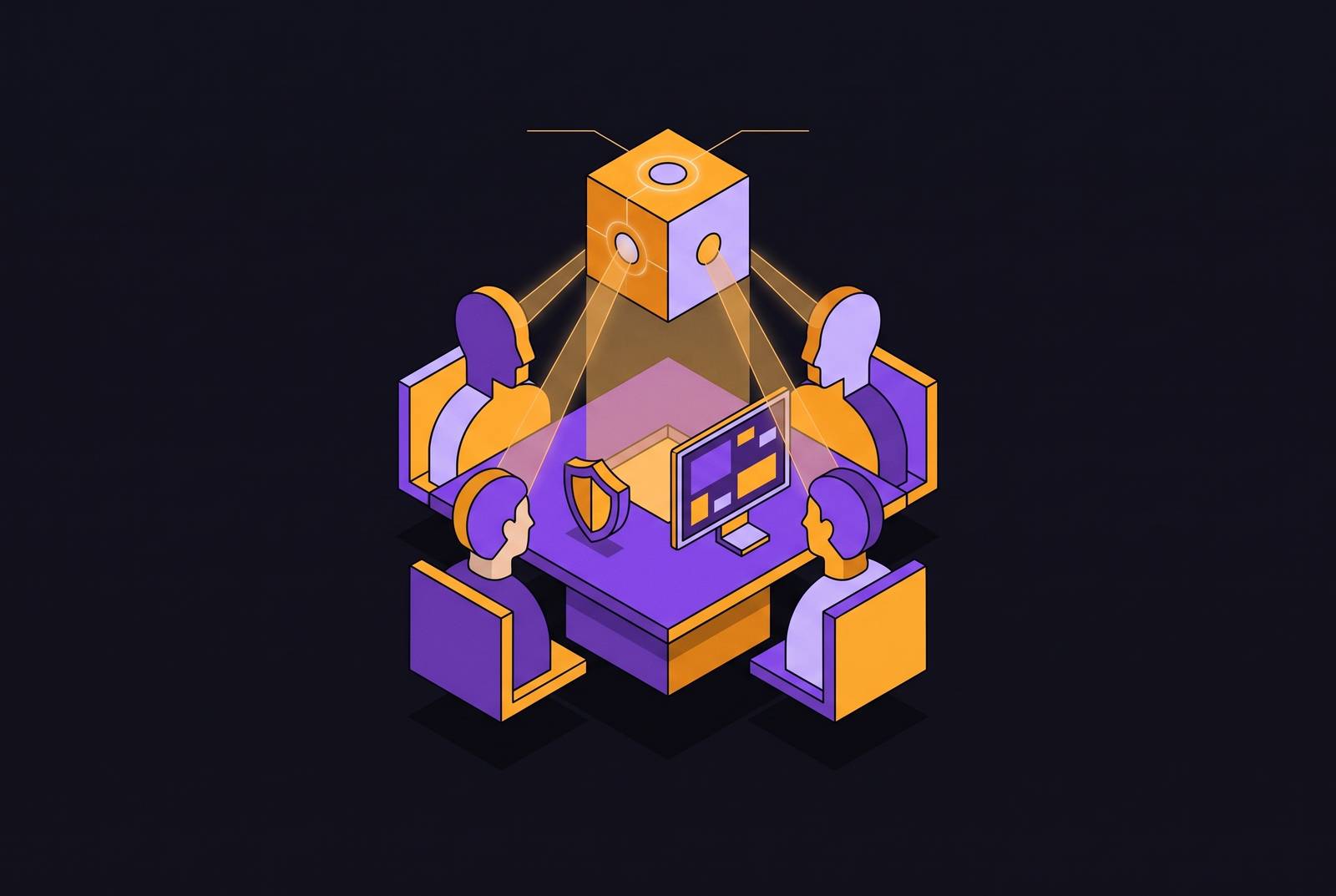
Someone glances at the participant list mid-meeting and sees it: "Circleback Notetaker." That single line of text does more social work than any disclosure policy, because it tells everyone on the call that something is listening, and that someone is watching who else is listening too. The underlying recording technology barely matters here. Circleback's own guide states the point: "Bot-based and desktop recording produce identical AI meeting notes. A bot joining the call generates a transcript and a summary; a desktop app capturing system audio locally generates the same transcript and the same summary. What differs is not the output but the room. When a bot records, its name sits in the attendee list for everyone to see, but when desktop recording captures audio from the host's machine, there's nothing to see. Since the two modes produce identical notes, every real argument for choosing one over the other is actually an argument about what visibility signals to the people in the conversation, and what that signal does to their willingness to speak freely.
How AI surveillance changes what people say in meetings
Visible monitoring changes behavior, and the change runs toward less openness, not more. A 2024 Cornell study by Schlund and Zitek, published in Communications Psychology, found that people under algorithmic surveillance perceived less autonomy, generated fewer ideas, and showed more resistance than people monitored by another human doing the same job, a measurable cost in which a visible AI recorder can shrink the number of ideas a group produces and make people more defensive about contributing them. But the same study found a way to largely erase that cost. But when the AI tool was framed as developmental, so it was positioned as something that helps people do better work rather than something that evaluates or polices them, the resistance and autonomy effects stopped being statistically significant. Framing carries as much weight as presence. A visible bot introduced as a surveillance mechanism produces a different room than the same visible bot introduced as a tool for focus and follow-through, even though the hardware and the output are unchanged.
The effect isn't constant across every kind of meeting either. The effect is strongest in exploratory or sensitive discussions, where people are testing half-formed ideas or disclosing uncomfortable information, and weakest in structured, task-oriented meetings where some kind of documentation was already expected before anyone opened a laptop. In an internal team standup or a sprint planning session, a visible bot tends to sharpen the conversation rather than flatten it: people state decisions more directly, name action items instead of letting them hang unspoken, and talk with the awareness that the record will be read later. In that setting the bot works as an accountability mechanism, not a surveillance one, because everyone in the room already assumed the meeting would be documented somehow. A bot that helps and a bot that chills are separated less by the technology than by what the room expected before it arrived.
The meetings where a visible bot earns its keep
Internal meetings built around shared documentation are the clearest case for visible recording. Standups, sprint planning, project syncs, all-hands meetings: in each of these, the people on the call already expect notes to exist afterward, nobody is caught off guard by a notetaker joining, and the presence of a visible bot signals that what's being said is being taken seriously enough to preserve. Sales discovery calls and product demos belong in the same category, but for a different reason. Telling a prospect that a notetaker is joining "so I can focus on our conversation rather than scribbling notes" is a statement of attention, not an apology. Circleback's guide frames this directly as a confidence move rather than an awkward one, and that framing tracks with how buyers tend to read the gesture: a rep who isn't splitting attention between a notepad and the conversation signals that the conversation matters.
The common thread across all of these cases is that the output is meant to be shared. Notes posted in Slack, action items routed into a project tracker, a summary circulated to a whole team: wherever the recording's purpose is to create a shared artifact, visible capture removes any ambiguity about what was recorded and who has access to it. Nobody has to wonder later whether a conversation was quietly captured. Everyone in the room watched the bot join, so the social contract is settled from that moment.
The meetings where a visible bot changes the room for the worse
The cases that matter most, and that most teams get wrong, involve conversations where candor is the entire point and a visible recorder makes that candor harder to get. Think of a diligence call with a target company's CFO, an LP call on a deal that hasn't closed, or a research conversation with an expert network participant. In each of these settings, a visible bot joining the call doesn't just record what's said, it changes what gets said. Participants grow guarded, sensitive numbers and context stop surfacing, and the dynamic that made the deal conversation useful in the first place breaks down. The same structural problem occurs in early-stage negotiations, confidential strategic discussions, and executive-to-executive talks between two organizations: the party on the other side of the table did not choose the AI vendor on the call, has no relationship with it, and has no particular reason to trust it with what they're about to say. A visible bot in that setting signals that the other side has lost some measure of control over the conversation. Many teams default to silent desktop recording for diligence calls, investor conversations, and confidential negotiations, since it keeps the other party candid.
HR conversations deserve a more careful version of the same logic. Complaint intake, workplace investigations, and performance management conversations are exactly the moments where an organization most needs an unguarded account from the person speaking, and a visible recording mechanism risks chilling that account before the investigation even gets underway. These conversations still need documentation; the goal is to capture them without putting a visible signal in front of the one person whose candor the process depends on. Expert network calls and research interviews run on the same mechanism: an expert who sees a named bot in the attendee list reads the call as "on the record in a specific system" in a way that shapes what they're willing to say, even when the underlying content of their answer wouldn't change if they knew a recording existed.
The practical answer to all of these cases is desktop capture: recording system audio from the host's device, producing the same transcript and the same summary as a bot would, without adding anyone to the participant list. Its one real limitation is that it depends on the host being present, since it reads audio from the host's own machine. A desktop recorder can't be dispatched into a meeting the host isn't attending the way a bot can.
Platform changes that made bot visibility a governance problem, not just a preference
Through 2026, the two largest enterprise meeting platforms moved to treat uninvited third-party bots as a default risk rather than a neutral guest, and that shift turns a social preference about recording mode into a question of platform access and compliance. Google Meet began flagging third-party notetaker bots as a "potential risk" and defaulting to denying them entry; a host now has to manually admit a flagged bot every time it tries to join. Microsoft made a parallel move in Teams: external meeting bots get detected and labeled in the meeting lobby under a "Suspected threats" heading with an "Unverified" indicator, visible to the organizer before anyone lets them in, with organizer approval now required. IT departments can now block all detected bots across an entire organization with a single policy change, but detection in both platforms runs on heuristics, so some bots may not get caught.
What matters for a team choosing a recording mode isn't how either rollout works in its exact mechanics, but that bot-based recording now carries structural friction that didn't exist before: a recurring admission prompt in Google Meet, and a reputational label sitting in a Teams lobby where every organizer and every participant can see it before the meeting even starts. A team that hasn't thought deliberately about recording mode is going to have that decision forced into view the next time a host has to decide whether to click "admit" next to a flagged bot, or explain to a Teams meeting organizer why an unfamiliar name is sitting under "Suspected threats."
Why consent law treats bot visibility as insufficient notice
If a bot's name sits in a participant list, people can tell a recording is probably happening, but no meaningful legal standard treats that as adequate notice or consent. Circleback's own guide is explicit on this point: "Consent is required in both modes. A visible bot is not legally sufficient notice. Disclosure must be explicit regardless of how you capture the audio." Consent under U.S. State wiretapping statutes and the GDPR both require informed agreement: the participant has to understand what's being recorded, how that recording will be used, who can access it, and how long it will be kept. A line item in an attendee list communicates none of that. GDPR adds a further complication specific to employment settings: employers generally can't rely on an employee's consent to justify recording a work conversation, because that consent may not be freely given when one party holds power over the other's job, so a different legal basis is required.
The direction of legal pressure on this question is visible in ongoing litigation. A consolidated complaint, filed December 5, 2025, alleges that a default recording configuration failing to notify non-users they were being recorded violated a wide stack of statutes, including ECPA, CFAA, CIPA, BIPA, and CDAFA along with other California laws, and that meaningful participant notification was only available on the most expensive enterprise tier. That lawsuit is still working through the courts and its outcome isn't settled, but you can see where regulators and plaintiffs are already looking. Legal conversations involving outside counsel carry an additional wrinkle: introducing a third-party vendor into the recording chain creates some risk of waiving attorney-client privilege, depending on the vendor's data practices and whether it can be treated as a necessary agent to the conversation. That question remains unsettled as a matter of law, so if outside counsel is in the meeting, you have reason enough to favor on-device capture. None of this is a substitute for legal advice specific to a given organization's jurisdiction and circumstances; counsel should be the one answering what notice and consent a given meeting requires.
What deliberate recording-mode policy looks like in practice
If an enterprise team runs both routine internal meetings and sensitive external conversations, it needs a standing answer to the recording-mode question for each meeting type, so the decision can't be left to whoever happens to be hosting that day. A workable version of that policy is simple to state: internal syncs and sales calls with willing participants default to a visible bot, while external negotiations, diligence calls, HR conversations, and anything involving outside counsel default to desktop capture paired with explicit verbal disclosure at the start of the call. Disclosure matters in both modes, not just the silent one. Because a visible bot doesn't count as legal notice on its own, every recorded meeting needs a spoken or written statement that recording is happening, regardless of which mode is running.
An organization that treats this as policy builds a different record over time than one that leaves it to individual habit. A norm of "turn it on if you want notes" produces a scattered mix of personal recordings with inconsistent coverage. A norm of "recording is on by default, with a clear opt-out," paired with the meeting-type framework above, produces something closer to a searchable institutional record. The tools that separate enterprise use from individual habit are governance controls: the ability for an administrator to set recording policy by meeting type, enforce information barriers between teams, or block recording outright when certain participants, such as outside counsel, are on the call.
Circleback is built around both modes. It supports bot-based joining for meetings where visibility is the right call, and a desktop app for meetings where it isn't, so you get the same notes, action items, and workflow connections either way. It works across online and in-person meetings, handles many languages, and connects into the tools teams already use for follow-through, including CRMs, project trackers, Slack, and Notion. The point of offering both modes isn't flexibility for its own sake; it's that the choice between them is a real decision with real consequences, and a tool built for enterprise use needs to support whichever answer a given meeting calls for.
Reading the room: a practical decision framework for recording mode
Three questions settle the recording-mode decision for any meeting: who is actually in the room, what do they stand to lose if they know the conversation is being recorded, and what does a visible recorder communicate to the people on the other side of the call. When every participant is an internal colleague who already expects documentation, and the notes are meant to live as a shared team artifact, you can go with a visible bot, and you need no disclosure beyond the team's standing norm around recording. When the call includes outside parties who chose to be on it but didn't choose the AI vendor running in the background, such as clients, prospects, partners, or investors, the right posture is a visible bot paired with explicit upfront disclosure and consent, unless the conversation depends on a level of candor that a visible recorder would suppress, in which case desktop capture is the better fit. When the conversation touches sensitive personal or legal territory, such as an HR complaint, a privileged legal discussion, a performance conversation, or a confidential negotiation, desktop capture with explicit verbal disclosure is the only defensible choice, and the prior question of whether to record the conversation at all deserves its own separate answer.
Across every one of these cases, disclosure is the floor, both ethically and, in a growing number of jurisdictions, legally, regardless of which capture mode is running underneath it. Bot visibility is a signal, not a virtue to maximize or a flaw to eliminate, and its meaning shifts with who's in the room and what they're being asked to say. If enterprise teams treat recording mode as a deliberate choice made meeting by meeting, rather than a default left on autopilot, they protect the legal standing of what they record and the quality of the conversation they're recording.