Notifying Meeting Participants That AI Is Recording
Legal rulings against AI meeting tools are reshaping consent requirements across jurisdictions.
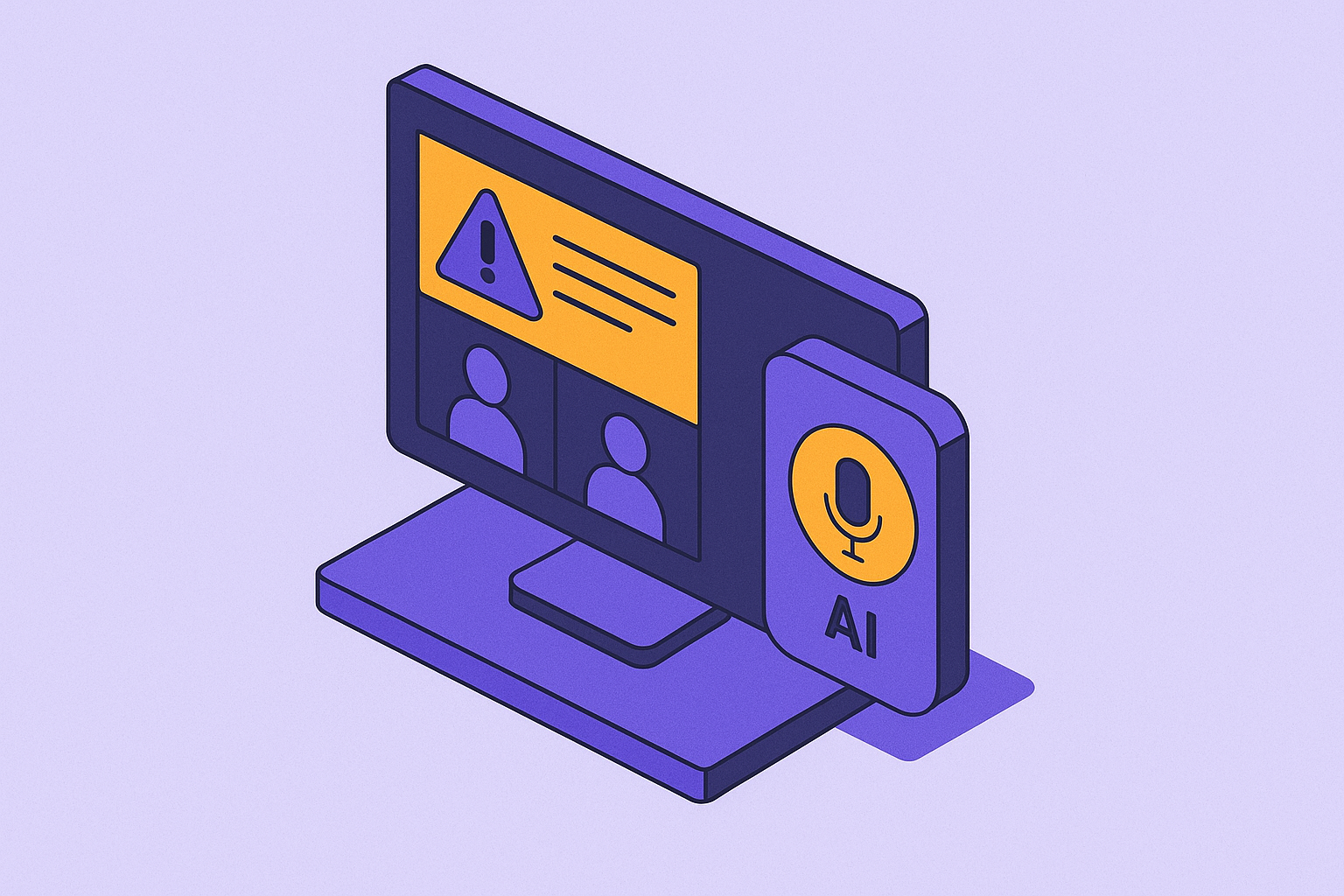
An AI notetaker joining a video call is not the legal equivalent of a human participant tapping "record," and treating it that way is the single most consequential mistake enterprise teams make when adopting these tools. The Electronic Communications Privacy Act sets a federal floor allowing one participant to record a conversation on their own authority, without notifying anyone else. That floor was written for a world where the person recording and the party consenting were the same actor. AI bots break that assumption, because the bot's role in the conversation, whether it counts as a participant or as a third party intercepting the call for its own separate purposes, is now a live legal question.
That question has already produced a consequential ruling. In Ambriz v. The capability to do so was enough to let the claim proceed past the pleading stage. That distinction matters enormously for any AI meeting tool that processes and stores conversation data beyond producing a simple transcript, because it means the exposure is created by what the system is capable of doing with the data, not only by what it has been shown to do.
A second case extends the same question to the industry as a whole. The consolidated federal class action in Brewer, argued before Judge Eumi K. Lee in May 2026, asked whether wiretap statutes drafted decades before AI transcription existed reach a bot that sits quietly in a video call, listening and recording without speaking. Judge Lee ruled on August 13, 2026, allowing the core wiretap and biometric claims to proceed, a decision that will shape legal exposure for every AI meeting product on the market, not just the one named in the suit.
AI tools also open up a second kind of exposure that human recording never did. A team that has handled wiretap consent correctly can still be out of compliance on the biometric side, because the two obligations arise from different acts: one from the recording itself, the other from what the system extracts from the voice.
How U.S. consent law applies when participants are in different states
Assuming that only the meeting host's state law governs a call is the most dangerous habit among teams using AI meeting tools, and it carries criminal exposure. Recording without consent from every participant can result in felony charges in nine of them.
The rule that governs mixed-location meetings is not additive, it is asymmetric. The strictest law in the room controls the entire session the moment one participant joins from an all-party consent state. A meeting with nine people dialing in from Texas and one person joining from Illinois is, for consent purposes, an Illinois meeting. Every participant on that call needs Illinois-level consent, regardless of where the other nine are sitting or what their own state would otherwise permit.
The penalties at stake vary by degree. Florida's exposure runs as high as five years. Illinois layers an additional penalty structure on top of its wiretap law through BIPA: written notice and a written release are required before a voiceprint can be extracted, and the statute does not accept a spoken disclaimer as a substitute.
For any team that sells or meets across state lines, the practical consequence is that an all-party consent requirement will apply on nearly every working day, not occasionally. Building a notification process that only satisfies one-party consent states leaves the organization exposed every time a call includes someone from California, Illinois, or any of the other eleven jurisdictions. A blanket opt-in policy, applied uniformly regardless of who happens to be on a given call, is the only default that holds up against that asymmetry.
What "Consent" Requires (and What Doesn't Satisfy It)
A visible bot in the participant list does not constitute consent. No jurisdiction treats the mere presence of a bot in a meeting roster as informed agreement. Valid consent requires that a participant understand what is being recorded, how the recording will be used, who can access it, and how long it will be kept.
Wiretap statutes and biometric statutes set different bars, and conflating them is a common source of error. Illinois's BIPA does not accept that same spoken disclaimer as adequate for biometric data. The statute requires written notice and a written release before a voiceprint can be extracted, a materially higher bar than announcing that the call is being recorded.
The Ambriz ruling adds a further wrinkle to what counts as risk, independent of what counts as consent. The court found that if you allege a vendor had the technical capability to use intercepted data for its own purposes, such as training a speech-recognition model, that's enough to establish third-party status at the pleading stage, even if no misuse is proven. Under California law, you're safer if you get explicit verbal or written consent before recording begins; if you rely on implied consent inferred from a platform banner, you carry real legal risk.
Voice data adds a layer of obligation that recording consent alone doesn't cover, and a notification process built only around recording consent will miss this layer. Meeting the wiretap bar is a necessary step, not the only one, and the next question for any team is how to deliver notice that satisfies both layers before a meeting ever starts.
Methods to notify participants before the meeting that hold up
The most defensible approach layers two methods rather than relying on either alone: written notice before the meeting, paired with a verbal announcement at the start of the session. Each covers a gap the other leaves open. Written notice reaches participants before they've joined and before any substantive discussion has started, so they get a real chance to object or decline. A verbal announcement reaches anyone who didn't read the invite closely, or who joined without seeing it, and it creates a spoken record that every participant had the opportunity to hear.
Calendar invite language should do specific work: state clearly that AI will be used to record and transcribe the meeting, name the tool being used or describe how the data will be handled, and give participants a concrete way to opt out or to request that recording be paused. The invite needs to function as actual notice, not as boilerplate.
The verbal disclosure at the start of a session does three things: it states that the meeting is being recorded and transcribed by AI, it identifies the tool or describes the process in plain terms, and it gives participants a window to object before the conversation moves into substantive territory. Courts generally treat continued participation after a clear verbal announcement as implied consent for wiretap purposes. The announcement has to happen before the discussion that matters, not during or after it.
Maryland's Department of Information Technology has built this dual-method approach directly into its policy. That structure, notice through one channel or the other, paired with a hard stop if consent is withheld, reflects what a defensible policy looks like at the institutional level.
Internal meetings and external meetings carry different risk profiles, so treating them identically understates the exposure you face on the external side. Under that model, the consent event happens at policy enrollment, when an employee or client agrees to the organization's recording practices generally, rather than being renegotiated in an ad hoc way at the start of every individual session.
Industries and roles that face stricter obligations than the baseline
Several professions carry disclosure duties that sit on top of state wiretap law, so if you practice in those fields, you can't borrow the generic notification language that works for an ordinary business meeting. Legal practice is the clearest example. The New York City Bar's Formal Opinion 2025-6 concludes that lawyers must notify clients and get their consent before they record conversations with AI-enabled tools. That duty holds even when only a summary of the conversation is ultimately retained rather than a verbatim transcript, because clients speak differently when they know a full record is being made, and the opinion treats that behavioral shift as part of what consent is meant to protect.
The competence duty under Rule 1.1 extends further than many practitioners assume. It now requires lawyers to understand where recordings are stored, whether the vendor trains its own models on client conversations, what a tool's default settings are, and whether content a user has asked to delete is actually deleted. These are part of what competent representation requires once an AI recording tool enters the workflow, and a marketing claim that a product is "built for lawyers" carries no legal weight on its own.
Healthcare carries its own layer. If you record telehealth sessions or clinical meetings, you're handling protected health information, so HIPAA obligations apply on top of whatever state recording consent law already governs. The two sets of requirements operate independently, and satisfying one does not satisfy the other.
Financial services face a comparable stacking of obligations. Platforms like GReminders, which launched an MCP server for financial advisors that integrates with Wealthbox, Redtail, PreciseFP, and Salesforce, have to navigate recording consent requirements alongside the data-handling standards that financial regulators impose separately. In each of these three fields, the lesson is the same: the professional ethics or regulatory layer sits on top of the baseline wiretap and biometric framework, and satisfying the baseline is necessary but not sufficient.
How GDPR and international rules change notification requirements for global teams
A meeting recording becomes personal data under GDPR the moment an identifiable person speaks, appears on screen, or is named in a transcript, and the consent approach that satisfies U.S. wiretap law routinely fails to meet that threshold. The two legal frameworks are built on different structures. U.S. wiretap law asks one thing: did the recording party get consent to record the conversation? GDPR asks whether the organization has a lawful basis to process personal data at all, and consent is only one of several available bases, not the default starting point.
Under Article 6 of GDPR, organizations can rely on legitimate interests, supported by a documented balancing test, contractual necessity, or explicit consent. An employer that frames recording consent as voluntary while making clear that refusal will be noted has not actually secured a lawful basis under GDPR's standard, regardless of what the employee signed.
Individual countries add further requirements on top of the GDPR structure. Germany treats recording a conversation without consent as a criminal offense under section 201 of its Criminal Code, not just a civil infraction, so the German standard sits closer to the felony exposure you'd find in states like Pennsylvania than to a typical civil privacy claim. Country-specific policy language is a requirement that a U.S.-drafted notification policy will not automatically satisfy, not a courtesy you extend to international participants.
The retention side of international compliance deserves equal attention. AI-generated summaries and transcripts are discoverable documents, so they carry the same legal hold and preservation obligations that apply to email, and they also count as personal data, so GDPR data subject access requests reach them too. A notification policy built only around how consent is obtained at the moment of recording leaves a gap on the back end: how long that data is retained, and who inside the organization can access it afterward, are questions the policy has to answer as well.
Bot-based vs. botless recording, how capture method changes notification obligations
Neither a visible bot joining the call nor a tool that captures system audio silently from the host's device eliminates the underlying consent obligation, and the two approaches create different notification dynamics. A bot that appears in the participant list gives every attendee a chance to see that recording is active, to object, to ask that it pause, or to leave the call. Regulators generally view this more favorably than covert capture, because the opportunity to object has been preserved.
That visibility is where legal exposure and participant trust intersect most directly. Covert capture removes the chance to object before the fact, and that removal is precisely why regulators treat it more harshly than visible capture.
Botless tools that pull system audio locally from the host's device carry a different burden, because you can't see them working. Pre-meeting written notice and a verbal announcement at the start of the session become more important under this model, not less, because they are the only signals participants have.
Neither method substitutes for the underlying legal requirement. If any participant is joining from an all-party consent state, the presence or absence of a visible bot has no bearing on whether consent has actually been obtained. If the bot's name appears in the participant list, that still does not, on its own, satisfy the legal consent requirement that the underlying statute sets.
Writing a recording consent policy that covers the actual risks enterprise teams face
A policy built from the material above has to do more than instruct staff to "get consent before recording." And it needs a retention and access schedule that treats transcripts and summaries as the discoverable, GDPR-relevant records they are, not as a byproduct of the meeting that can be ignored once the recording itself has been consented to.
The organizations that get this right are not the ones with the cleverest banner language. They are the ones that have mapped which legal regime governs each meeting before the meeting starts, and built notification practices that satisfy the strictest standard in the room.