On-Device Audio Processing for Meeting Privacy
Local processing keeps sensitive meeting audio off vendor servers and outside legal discovery.
Most buyers evaluating AI meeting tools compare the wrong variable. They weigh transcription accuracy, summary quality, integrations, and price, treating these as the dimensions that separate one product from another. The more consequential difference is architectural: where does the audio go the moment a meeting ends. Two fundamentally different designs sit side by side in this market. One is cloud-first, where audio leaves the device and travels to vendor servers for processing. The other is on-device, where a speech recognition model stored locally converts audio to text without ever touching a network connection. This distinction matters most for the meetings that feel least risky in the moment: strategy sessions, HR conversations, legal calls, board discussions, the exchanges where candor runs highest and the cost of exposure runs highest with it.
What cloud-first architecture does with your audio
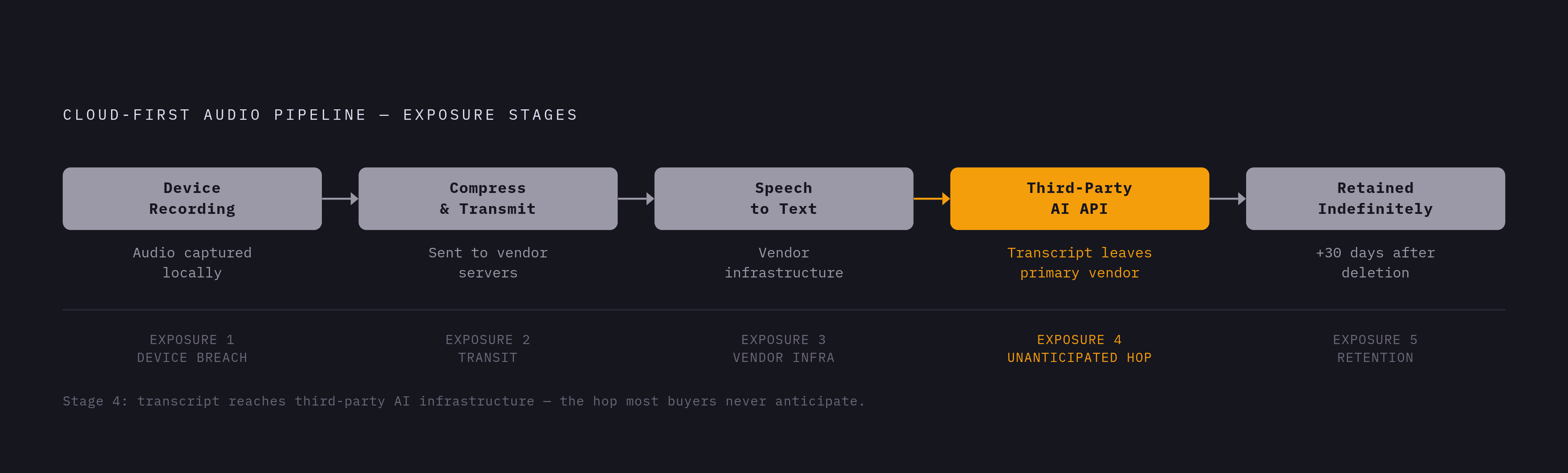
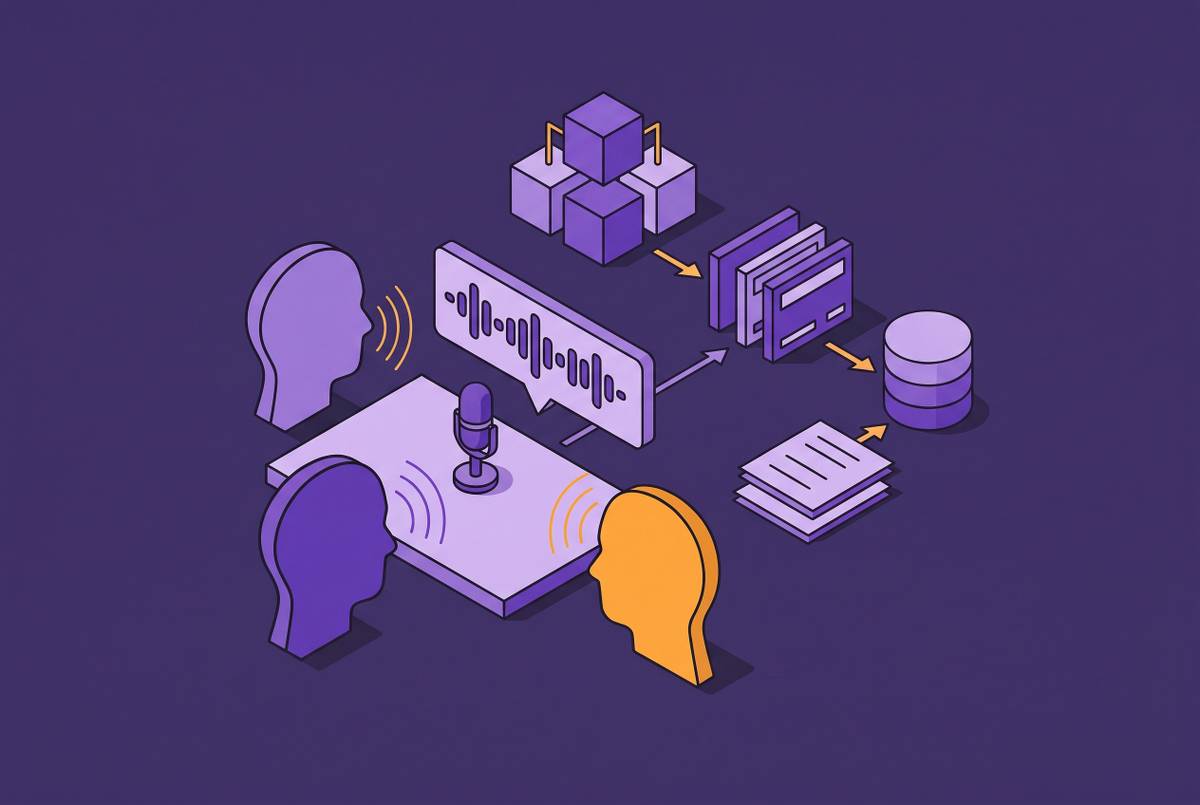
Cloud-first tools follow a consistent pipeline. Audio is recorded on the device, compressed, and transmitted to vendor servers, where speech-to-text models convert it into a transcript. That transcript, along with the underlying audio, is stored on infrastructure the user does not own or control, then returned to the user as a finished product. What happens to that audio afterward depends heavily on the vendor. A review of major AI meeting recorders found that most store audio indefinitely, and one tool's policy specifies that recordings are retained until manually deleted, with account data held for a further 30 days after deletion. Deletion requests do not always reach every copy of the file: backup systems, log files, and machine learning pipelines can retain audio well after the primary recording is nominally removed.
Summarization introduces a second point of exposure. As of the same March 2026 review, at least one widely used tool sends transcripts to cloud AI APIs for summarization, so meeting content reaches third-party AI infrastructure even when the vendor's own storage practices seem reasonable. That same tool's policy states it may use de-identified data to train its own AI models, with the burden of opting out, available in account settings, placed on the user. End-to-end encryption, often cited as a safeguard, does not close this gap. Encryption protects audio while it travels between the device and the server, but the server itself must decrypt that audio to process it. It holds raw audio regardless of whether anyone intercepted the transmission.
What voice data contains, beyond the words spoken
Meeting audio carries far more than a record of what was said. Embedded in the acoustic signal is biometric, emotional, and health-indicative information that most participants never think to account for. A voiceprint, derived from vocal cord length, throat shape, and habitual speech patterns, is distinctive enough that banks and law enforcement agencies already use voiceprint matching for authentication and identification. The claim that a voiceprint is as statistically unique as a fingerprint has not been fully validated by the scientific and forensic communities, a caveat that matters because the technology is deployed as though that certainty already exists. What makes a compromised voiceprint different from a compromised password or credit card number is permanence: a password can be reset, but the physical dimensions of a person's vocal tract cannot.
Voice recordings also function as a partial health record. Machine learning models can extract indicators of emotional state, fatigue, respiratory conditions, neurological conditions including Parkinson's disease, and cognitive decline directly from recorded speech. A longitudinal archive of meeting audio, accumulated over months or years of routine calls, amounts in practical terms to a partial medical record, built without explicit consent from anyone on the call. HIPAA does not reach this archive unless it is created or held by a covered entity or business associate and contains individually identifiable health information, a narrow condition that most meeting recordings never satisfy. The exposure multiplies with every additional participant on the call: a single HR conversation can carry biometric and behavioral data from the manager, the employee, a colleague, and a legal advisor, all captured in the same file. Where any of that audio is absorbed into a model's training data, the absorption is permanent. Once incorporated, it cannot be extracted back out.
The legal exposure that cloud storage creates, and the cases making it concrete
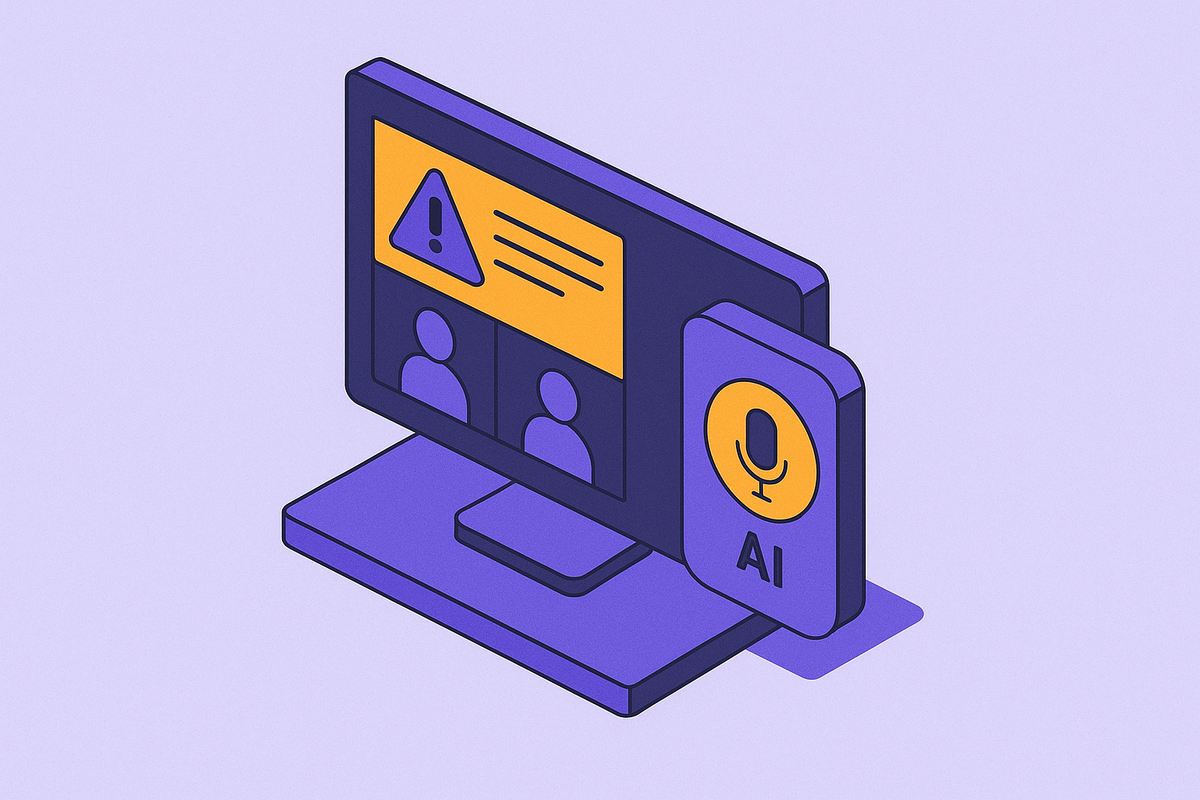
Cloud-stored meeting transcripts and recordings are permanent, time-stamped, searchable business records, and that combination makes them almost certainly discoverable in litigation and regulatory investigations. Because a third-party vendor holds the data rather than the account holder, that data can be subpoenaed directly, with consequences the account holder has no ability to control. The exposure is sharpest around attorney-client privilege. Sending privileged client communications to a cloud AI API creates a disclosure to a third party, and mainstream legal ethics analysis treats that disclosure as a risk to privilege itself. The New York City Bar Association's Formal Opinion 2025-6 states that clients must be notified, and their consent obtained, whenever their calls are being recorded by an AI-empowered system.
The courts have already begun to test this. In United States v. In one federal court ruling, the court held that a defendant lost both attorney-client privilege and work-product protection over content he shared independently with a public consumer AI tool, without attorney direction and without a reasonable expectation of confidentiality under that tool's own privacy policy. The ruling was limited to unsupervised use of a public, non-enterprise AI tool and did not address enterprise AI or counsel-directed use, a distinction that matters for how broadly the precedent should be read, but the core lesson holds regardless of that limit: a disclosure to a third-party platform can waive protections that took years of case law to establish.
Liability does not stop with legal counsel. Vendor terms of service typically place consent responsibility on the account holder rather than the vendor, and wiretap law's procurement rule reaches the person who configured the recording bot and let it auto-join a call, not only the company that built the software. Consent requirements vary sharply by state. California, Illinois, Florida, Maryland, Massachusetts, Montana, New Hampshire, Pennsylvania, and Washington all require every party on a call to consent before recording begins, not just the person who initiated the meeting. A team that has never reviewed its meeting tool's data handling practices has already made a legal decision about where its audio goes and who can compel its disclosure. That decision was made passively, by default.
On-device processing and the hybrid gap
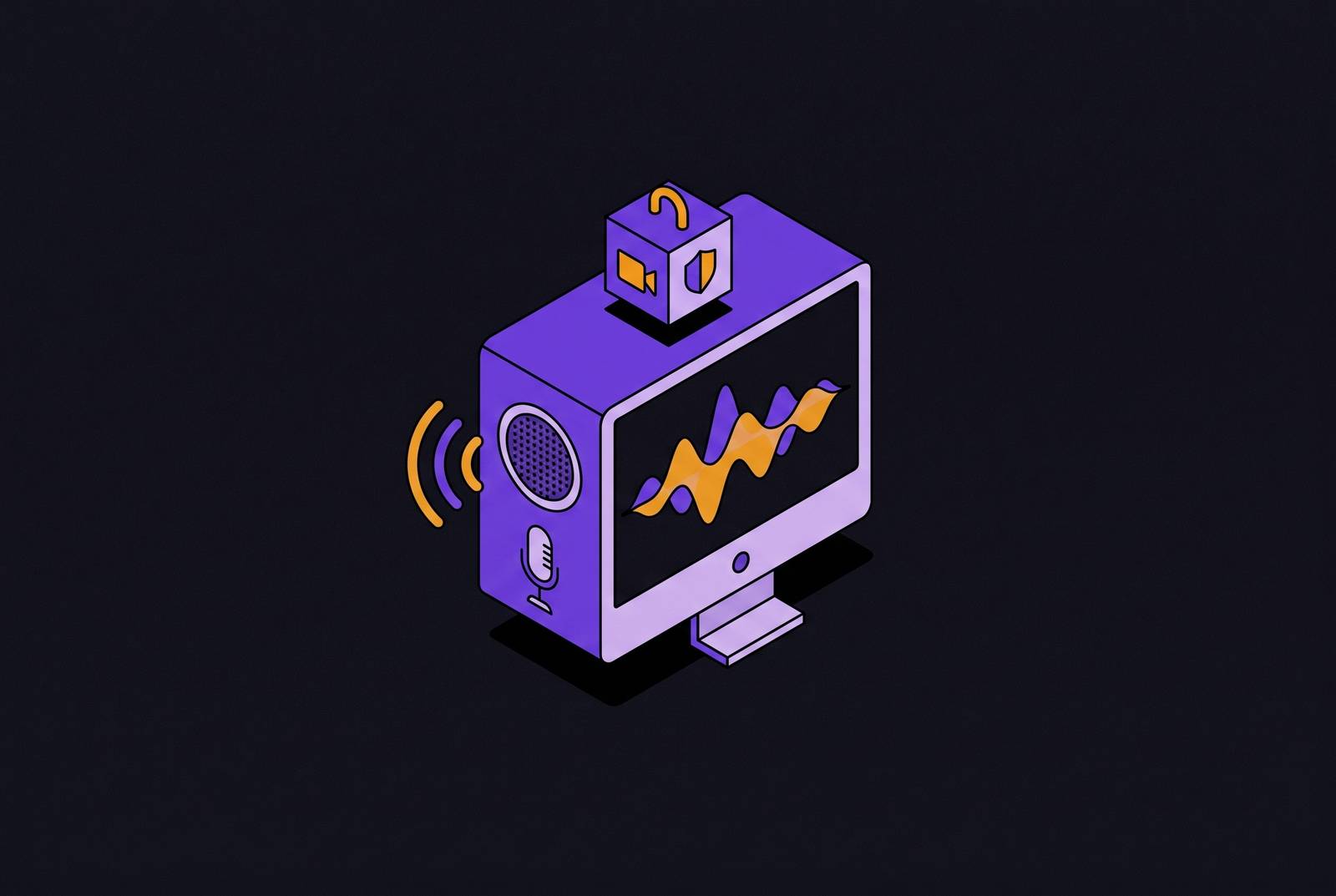
On-device processing means a speech recognition model stored directly on the device converts audio to text using local compute. No audio leaves the machine, no network connection is required to produce a transcript, and no third-party server ever receives the raw audio buffer. This has become possible at consumer scale because of a shift in hardware: neural engine chips paired with efficient open-weight models now let AI workloads that once required server infrastructure run on a laptop or a recent smartphone.
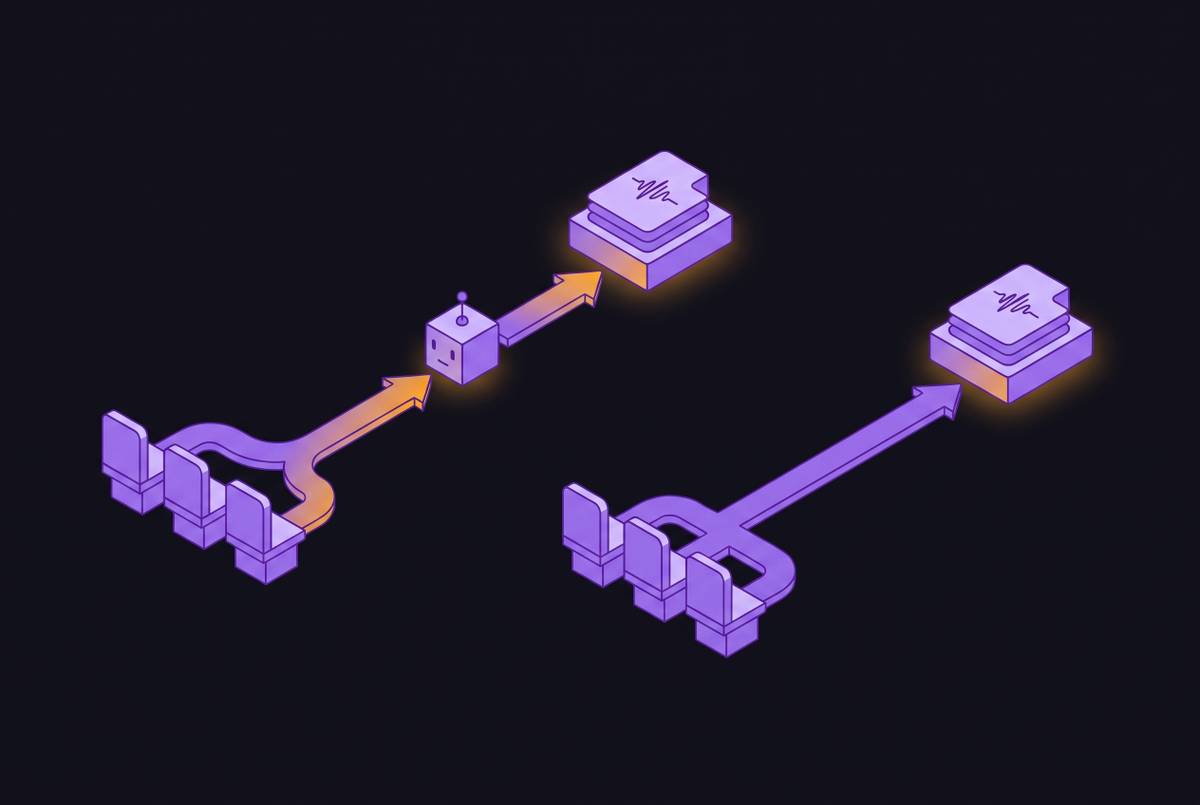
The term "on-device" gets used loosely, and the gap between the label and the actual architecture matters. A tool can perform transcription entirely on-device and still send the resulting transcript to a cloud AI API for summarization. Meeting content reaches third-party infrastructure anyway, just later in the pipeline than a fully cloud-first tool. A review found that one tool, Hedy, was the only one in its comparison set that runs speech recognition on-device by default, offers a fully local AI mode, and keeps both storage and AI analysis in Europe when the EU region is selected, while competing tools offering EU storage could still process data outside the EU. A different architectural pattern separates transcription from automation entirely: one approach processes audio locally on-device by default through a tool called Geode, while a separate automation layer, OpenClaw, captures and routes audio to Geode for on-device transcription, then routes only the resulting text outputs into downstream communication workflows. That design limits cloud exposure to the summarized output. The practical test for any buyer evaluating these claims is to ask, at each stage of the pipeline, whether content reaches a server at all, and if so, whether that content is audio, transcript, or neither. That answer, not the marketing language on a pricing page, determines the actual privacy profile of the tool.
What GDPR compliance requirements clarify about privacy architecture
GDPR does not prohibit cloud processing of meeting data, but it turns the architectural questions raised above into enforceable requirements, so it works as a useful standard for any team evaluating privacy architecture, whether or not that team operates in Europe. The regulation requires a documented legal basis for every data transfer outside the EU, a formal Data Processing Addendum with every processor that touches the data, and transparency about every sub-processor in that chain. A review published in January 2026 and updated in September 2026 lays out what GDPR-compliant architecture requires in practice for AI meeting tools. On-device transcription satisfies the requirement outright, since no transfer occurs; the alternative is an EU residency option that keeps data on servers physically located within the EU. Every processor relationship needs an Article 28 Data Processing Addendum backed by documented Technical and Organizational Measures. For any transfer to a country without an EU adequacy decision, the vendor needs Standard Contractual Clauses and a Transfer Impact Assessment, unless the recipient is a certified US organization covered by the EU-US Data Privacy Framework adequacy decision, in which case no additional transfer tools are required under Article 46. Vendors also need binding no-training agreements with every AI sub-processor in the chain, not just the primary vendor the customer contracted with.
The same review notes a common gap: tools that offer EU storage at the enterprise tier may still process that data in the US, which makes the storage location compliant on its face while the processing itself remains subject to transfer rules. The EU AI Act adds a further layer on top of GDPR. Its enforcement deadline of August 2, 2026 brings mandatory disclosure, consent, and biometric data obligations to every AI meeting notetaker used on a call with EU participants. On-device processing reduces how much of that compliance burden applies in the first place, simply because less data moves through pipelines the regulation is built to govern.
Where MCP and organizational memory create new privacy tensions
Meeting tools are increasingly connecting to AI assistants through MCP, the open standard introduced by Anthropic and since adopted across OpenAI, Google, and Microsoft. That connection turns meeting content into queryable context inside tools like Claude, and it delivers real productivity gains while it raises real new questions about where data flows. An AI assistant connected this way can query a full meeting archive, retrieve action items, surface past commitments, and draft follow-ups without the user switching tabs, turning every past meeting into searchable context inside tools teams already rely on daily. Pre-meeting briefings can be generated automatically by pulling CRM account data alongside a day's scheduled calls, and after the meeting ends, the same pipeline can extract action items, update CRM fields, and draft follow-up emails on its own. Bidirectional MCP, where a meeting tool both exposes its data to external systems and pulls context back from them, extends this capability further, and with it, extends the amount of infrastructure that meeting content must pass through to do its work.
That extension creates a structural tension. The richer the MCP integration a tool offers, the more meeting content passes through cloud infrastructure to make that integration function. Tools that keep transcripts fully local currently carry a smaller MCP surface by design, so the privacy benefit of staying on-device and the workflow benefit of deep AI integration pull in opposite directions. Organizational memory makes this tension durable. A searchable archive of every past conversation is a genuine asset for onboarding new employees and preserving institutional continuity. That same archive, sitting on cloud infrastructure, is also a larger and more permanent target for breach, discovery, or subpoena, a fact that does not diminish its value but does change what it costs to keep it.