Audio Data Retention and Deletion Policies for Meeting Tools
What your meeting tool's privacy policy doesn't tell you about audio deletion.
A buyer evaluating an AI meeting tool reads the privacy page, finds language about encryption and "industry-standard security," and assumes that deleting a transcript after a sensitive acquisition conversation means the conversation is gone. It doesn't mean that, and the policy never promised it did. A privacy policy describes what a vendor is permitted to do with data, not what the system actually does by default when a meeting ends. The questions that determine real exposure are architectural: where the audio travels before it's processed, when it gets deleted, and what copies survive that deletion. The gap between stated policy and actual behavior, not the policy itself, is the real subject of risk assessment here, because most privacy pages never spell out these defaults in plain language.
The three architectures that determine your actual retention risk
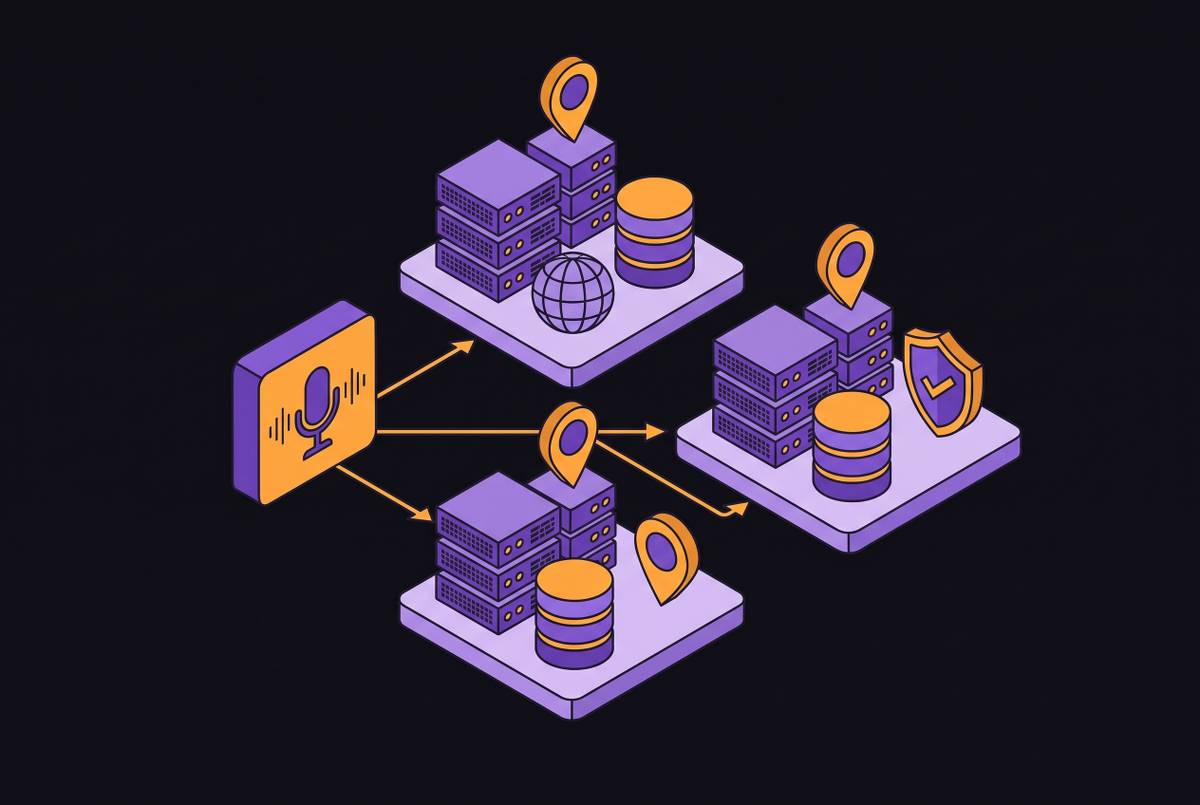
Three distinct architectures govern how AI meeting tools handle audio, and each produces a different retention profile regardless of what the privacy policy says. The first sends a bot into the call as a visible participant; it uploads audio to remote servers for transcription and returns a summary once processing finishes. Audio in this model passes through the vendor's own infrastructure, and often through subprocessors such as transcription APIs or third-party AI providers, before any deletion request can even take effect; each stop has its own backup schedule, so each one adds its own lag before the data actually disappears.
The second architecture skips the bot. The host's device captures microphone and system audio directly, then sends it to cloud APIs for processing, so other participants never see a bot join the call. Tools like Circleback that automatically capture and store meeting intelligence need to be evaluated first on their architectural defaults: where audio goes before it's transcribed, when the audio itself is deleted, and whether those actions happen without user intervention, because the privacy policy describes what is permitted. The OpenAI ChatGPT Meetings plugin, launched at DevDay 2026 on September 29, 2026, follows this same pattern: it captures audio through the Mac's microphone and system audio, processes it to produce summaries and action items inside ChatGPT Space, then deletes the audio once processing is complete, with no replay and no archive. The risk surface here is narrower than the bot-join model, since fewer infrastructure stops are involved, but it isn't eliminated, because audio still leaves the device and reaches external servers.
The third architecture keeps audio on the device. Transcription runs locally, so there's no server copy and no backup snapshot, and you have no subprocessor retention window to track down. Deletion in this model is immediate and structural. Fully on-device systems can lag behind cloud-backed tools in language support, summary quality, or depth of integration with other software. This architecture remains the least common of the three despite offering the cleanest privacy profile.
None of these three architectures is categorically superior. Each one trades some mix of convenience, accuracy, and integration depth for a different retention risk, so if you want to evaluate a tool honestly rather than trust its marketing language, you need to know which architecture it uses.
How defaults shape your exposure
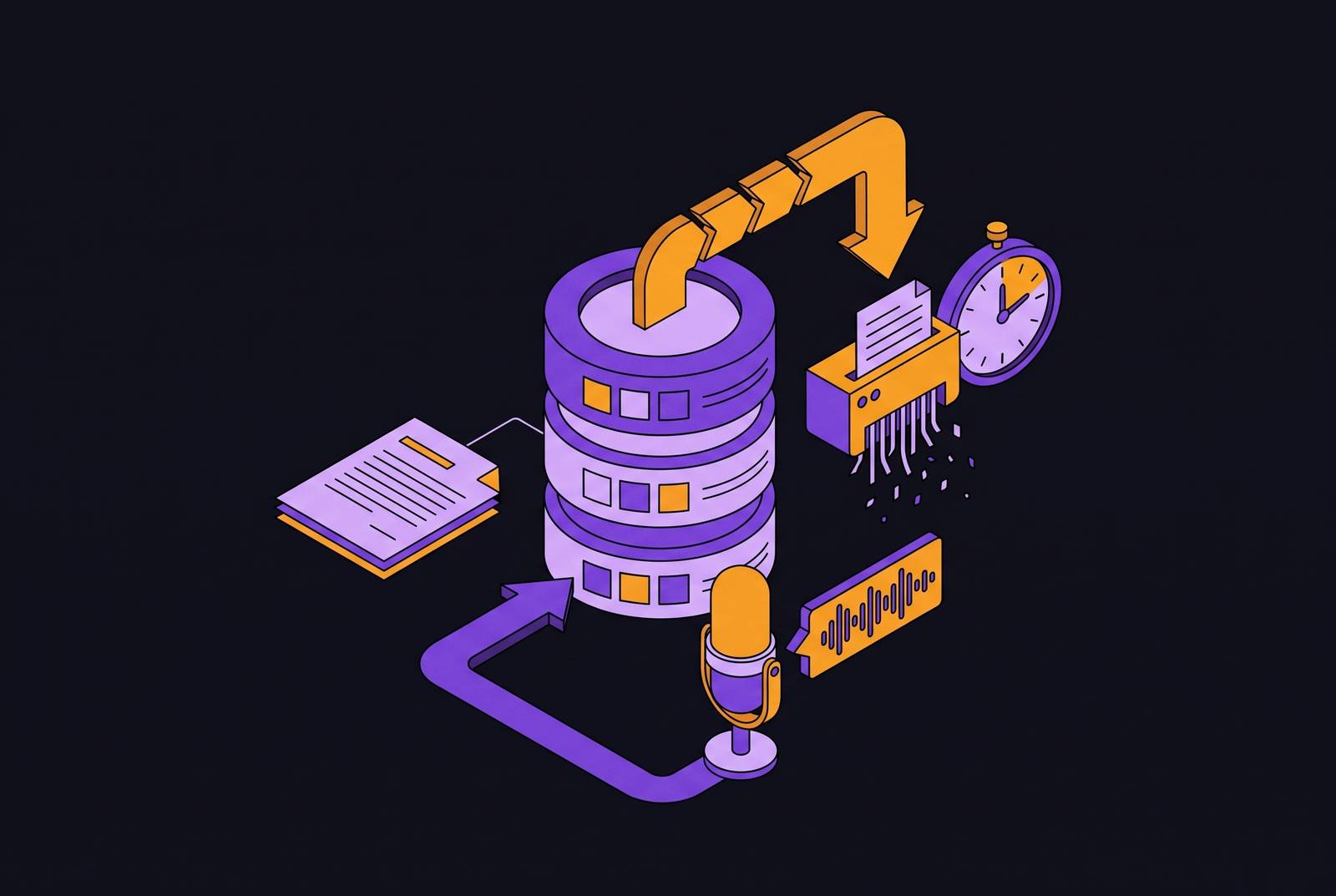
Within any of the three architectures, what matters most is the vendor's default behavior, not its deletion capability, because most users never issue a deletion request, and retention permitted by policy continues indefinitely until someone acts. The market splits roughly into three default postures. Some tools delete audio automatically once a note has been generated, so you get the safer outcome without doing anything. Others retain audio until the user manually deletes it. Exposure accumulates quietly across every meeting that goes untouched. A smaller group stores no audio at all, processing it in real time so that zero retention is a property of the design itself.
Upheal's 2026 retention guide, built for healthcare and therapy contexts, makes the stakes concrete when it distinguishes between session audio and the signed clinical note. Session audio is a working file, and you should delete it once the note is signed, but the signed note itself is the actual legal record, and state law governs it for years. If you hold audio beyond the note's drafting window, you hold the most sensitive category of data with no clinical or legal justification left for keeping it. The same logic extends well past healthcare. Audio of a board discussion or a sales negotiation is a working file the moment a summary exists to replace it, and every additional day it sits on a server is a day it can be subpoenaed, breached, or used in some way the policy technically permits but the participants never anticipated. The architectural choice to delete audio automatically once the note is generated, rather than leaving deletion to a manual request, is the difference between a default that eliminates risk and one that leaves it to accumulate invisibly, meeting after meeting.
The backup loophole that makes deletion harder than it sounds
Even a vendor that commits in writing to deleting data on request runs into a structural problem: traditional cloud backup architecture was not built for selective, immediate erasure of individual records. A deleted meeting can persist in backup snapshots long after the user believes it's gone, simply because the backup system was designed for disaster recovery, not for picking out and removing one file on demand. Most cloud AI services cite "backup systems" as the reason deletion isn't instant, and that explanation is usually genuine. It reflects a real technical constraint, not a dodge.
GDPR grants individuals the right to erasure "without undue delay," and data protection authorities generally expect that deletion to happen within one month. But GDPR's own backup provisions acknowledge that backups may temporarily block immediate deletion, requiring removal only "as soon as reasonably possible," a standard that few vendors have built the infrastructure to meet quickly. The subprocessor chain makes this worse: audio that has passed through a transcription API or an external AI provider may sit in that subprocessor's own backup system, under its own retention schedule, entirely outside the primary vendor's control unless the contract specifically requires otherwise. In practice, "we will delete your data on request" and "your data will be gone within hours of your request" describe two very different realities, and the language in most privacy policies makes no effort to distinguish between them.
What GDPR, HIPAA, and state wiretapping laws require of AI meeting tools
AI meeting tools sit at the intersection of three separate legal regimes, data protection law, sector-specific health privacy rules, and state consent-to-record statutes, and satisfying one of these regimes offers no guarantee of satisfying the others. Under GDPR, voice counts as biometric data under Recital 51 and Article 9 when it's used for identification, so audio recording is one of the highest-risk categories of data the regulation addresses. The safest architecture under GDPR processes audio in memory, transcribes it, discards the audio buffer immediately, and persists only the resulting text, achieving zero audio retention by design. EU hosting does not solve this on its own: hosting data on EU servers under a US-controlled parent entity does not amount to sovereign data residency, because the CLOUD Act reaches data regardless of where the server physically sits, a fact that disqualifies a meaningful share of the market for organizations that need genuine EU data residency. A data processing agreement that fails to list its subprocessors or spell out deletion and return procedures doesn't meet Article 28's requirements, and "DPA available on request" is itself a signal that the agreement isn't part of the standard contract a buyer is being offered.
HIPAA adds a separate layer of obligation. Disposed protected health information must be rendered unreadable, indecipherable, and unable to be reconstructed, not simply moved to a trash folder or flagged for later removal. A transcript counts as protected health information in healthcare settings even without the underlying audio, so if a tool deletes the audio but keeps the transcript, it hasn't actually eliminated the PHI it's responsible for.
State wiretapping and consent laws add a third, independent layer. Roughly 11 to 13 U.S. states, depending on how hybrid jurisdictions get counted, require all-party consent before a conversation can be recorded, and penalties under these statutes stack quickly on a per-violation basis. No jurisdiction currently treats the visible presence of a recording bot in a participant list as legally sufficient notice or consent on its own. A formal ethics opinion from a bar association concludes that an attorney should obtain client consent before recording a call and must not violate professional conduct rules through deceptive use of recording tools, a conclusion that reflects a broader principle: informed consent requires that a participant understand what is being recorded, how it will be used, who can access it, and how long it will be kept.
Reading a retention policy against its architecture
If you want to evaluate a vendor's retention posture, you need to read the policy against the architecture it implies and ask questions specific enough that a vague answer becomes disqualifying. The first question asks whether audio is deleted automatically once the note is generated or only when the user requests it, and the vendor's documentation should state that answer directly. The second asks whether deletion extends to the transcript or whether the transcript survives after the audio is gone, since a transcript is derived data that vendors often treat separately, and silence on this point is itself a kind of answer. The third concerns the subprocessor list and whether a vendor's no-training commitment extends contractually to every subprocessor on it, because a commitment that doesn't bind subprocessors has a gap in it: audio can reach a transcription API whose own default behavior includes training on customer inputs unless a contract specifically forbids it. The fourth asks how long data persists in backup systems after a meeting is deleted or an account is canceled, and "a reasonable period" isn't an acceptable answer; a concrete number, such as thirty days, is. The fifth applies specifically to vendors whose parent company is incorporated in the United States: what CLOUD Act exposure exists for data stored on EU servers, since EU-region hosting under a US-controlled entity is not the same thing as genuine data residency. These five questions work as tools a buyer can bring into a vendor conversation, not abstractions to mull over afterward, and a vendor's inability to answer any of them concretely tells a buyer as much as a confident answer would.
The delete-after-processing design
A growing segment of the market has converged on a design that keeps the summary and action items while discarding the raw audio once processing finishes. This reduces the retention surface considerably, but it trades away something real: the ability to go back to the original recording. Incumbent meeting bots built their value around persistent, searchable archives of everything said in a meeting, so if you got used to pulling up the actual recording, you lose that under a delete-after-processing model. That trade-off deserves to be taken seriously rather than waved away, because for some teams, particularly those in legal, investigative, or highly technical contexts, the ability to replay the exact wording of a conversation carries real value that a summary cannot fully replace.
For many organizations, though, the smaller retention surface is the trade that pays off more. Legal departments and HR teams that have grown wary of persistent recording archives generally find a narrower footprint easier to manage, because when fewer records are stored, fewer discovery obligations follow, and exposure under GDPR narrows too. Circleback's approach reflects this logic: it aims to produce notes accurate enough that users rarely need to return to the original recording, treating the derived artifact, not the raw audio, as the actual point of the exercise. Under this philosophy, the value of organizational memory comes from searchable, well-structured notes and action items that flow directly into the tools where work already happens, not from maintaining an audio archive indefinitely. If you keep raw audio past the window needed to generate that summary, you add more risk than value for most organizations, even though a smaller set of use cases that genuinely depend on replay still need it.
A meeting data strategy for organizations that delete audio
Deleting audio after processing removes the highest-risk layer of retention, but governance obligations continue. Transcripts, summaries, and action items are themselves records with legal, compliance, and organizational weight, and each requires explicit handling rather than an assumption that deleting the audio took care of everything. Discovery risk applies just as much to these derived artifacts as it once applied to a recording: a meeting that used to exist only as spoken words now exists as a transcript, a summary, and a list of action items, each one potentially discoverable and each one capable of contradicting other evidence in a dispute. Retention schedules and legal-hold templates need to address AI-generated meeting content specifically, so an organization can preserve what the law requires it to preserve and delete what it doesn't.
There's also a genuine upside to retaining the derived artifacts, even where the audio itself is gone. When meeting content is searchable and well summarized, new team members can review past context, decisions, and commitments without waiting months to absorb it through osmosis, and teams spend less time re-litigating conclusions that are already sitting in an accessible record. That value depends on a policy that treats all four artifacts distinctly. Audio should be deleted once the note is finalized, or never stored at all where the architecture allows it. In regulated contexts, you should treat transcripts with the same seriousness as audio and give them an explicit, documented retention period. Summaries and notes typically function as the durable record, so you should retain them for as long as organizational or legal need requires, with clear access controls attached. Once you push action items and CRM entries downstream into project tools or customer systems, they take on the retention lifecycle of whatever system they land in, and the meeting tool's own policy no longer governs them.
Tools built around routing notes and action items directly into CRMs, project management software, and communication platforms, the integration model Circleback is built around, make this governance easier in practice, because the artifacts end up living inside systems that already have their own retention and access policies rather than accumulating indefinitely inside a standalone meeting tool's database. Understanding a vendor's architecture and defaults is the first step toward managing retention risk. Building a four-artifact governance policy, one that treats audio, transcripts, summaries, and downstream action items as four separate questions rather than one, is the second, and choosing a tool whose design already aligns with that structure makes the second step considerably more manageable.